














Tissue and towel producers have long accepted PAE’s limitations as the price of reliable wet strength performance. A new generation of GPAM chemistry by Kemira is changing the calculation, delivering both cost savings and performance improvements where conventional programmes have historically fallen short. Vladimir Grigoriev, Head of Application Excellence, Kemira, Packaging & Hygiene Solutions, Americas, reports for TWM.
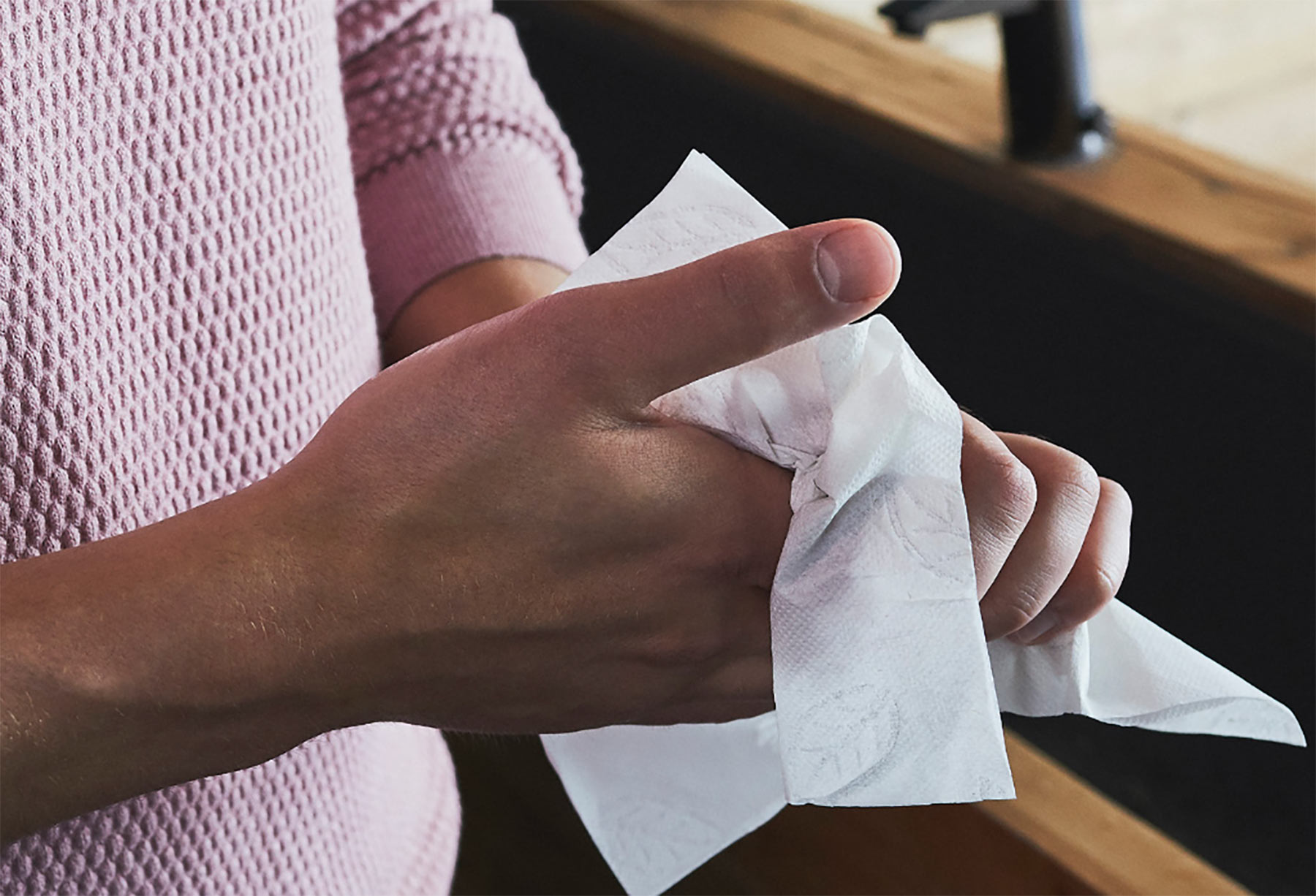
Wet strength is non-negotiable in towel grades. Whether the application is AfH dispensing or consumer use, a towel that falls apart when wet fails its most basic job. For decades, polyamidoamine-epichlorohydrin (PAE) resin has been the predominant chemistry for towel producers to meet that requirement – and for good reason. PAE delivers reliable, permanent wet strength across a wide range of furnishes and operating conditions. But it comes with a set of trade-offs that have become harder to ignore.
Conventional PAE programmes are frequently associated with high cost in use and machine runnability headaches: foam, felt plugging, and the need for balancing the process charge. PAE resins’ performance comes from covalent self-crosslinking mechanisms that are stable in aqueous environments, but the same bonds contribute to poor repulpability and recycling challenges, especially when it comes to aged converting broke. Elevated PAE use can also work against absorbency rate, which is an important performance attribute in towel grades.
In addition, the presence of epichlorohydrin-derived by-products has added sustainability and regulatory weight to the conversation. The tissue industry has been motivated to find alternative chemistries that reduce or eliminate these carcinogenic chloro-organic components, provide more flexibility in strength decay behaviour, and improve repulpability – without compromising performance.
Advances in GPAM technology
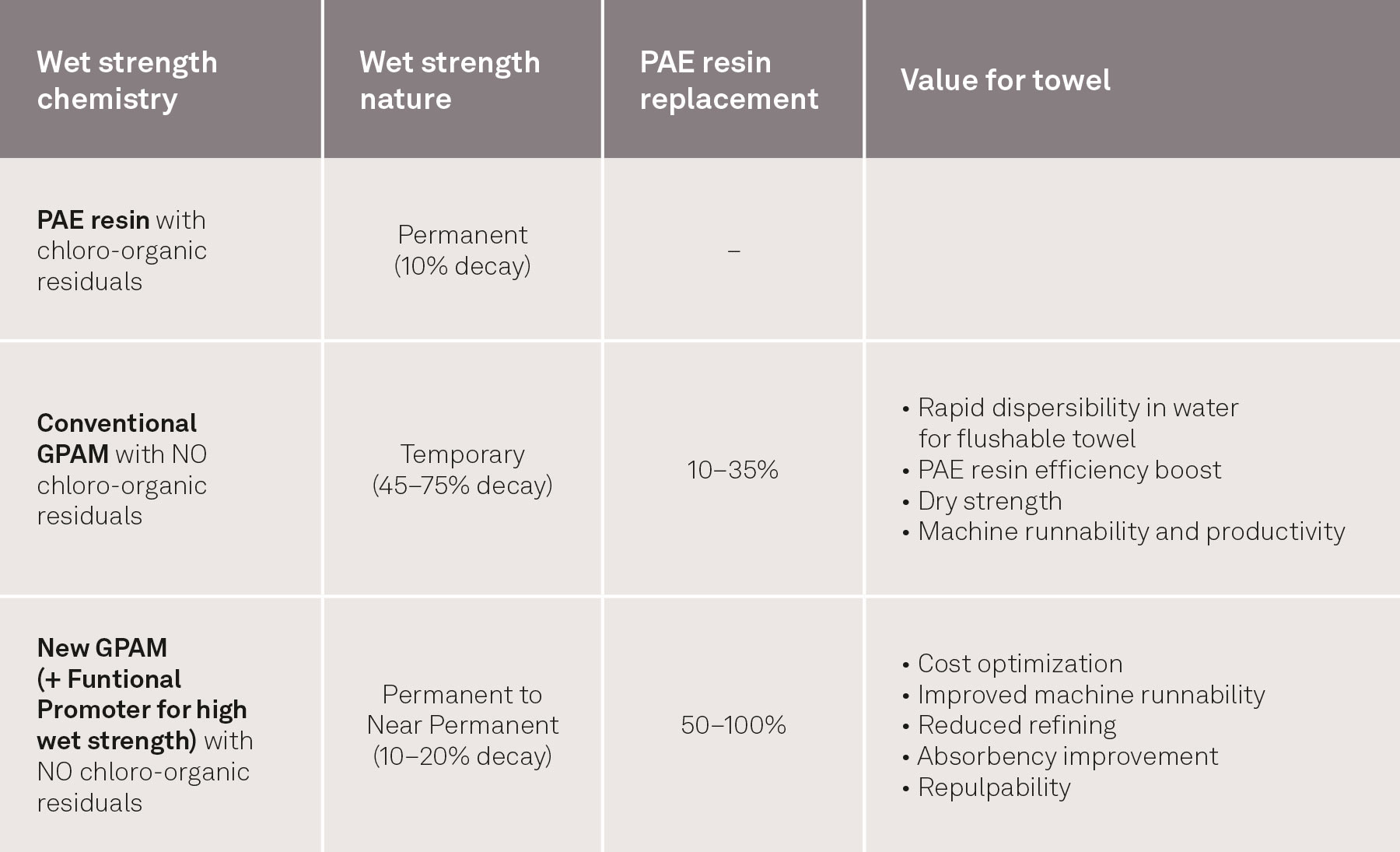
Glyoxalated polyacrylamide (GPAM) resins have been a part of the tissue and towel producer’s toolkit for a long time, but primarily for enhancing dry strength or temporary wet strength, and never for permanent wet strength. The fundamental limitation of GPAM as a wet strength agent is simple: a GPAM-treated sheet loses strength fast during prolonged water exposure. The decay rate of conventional GPAM is 45–75% after 30 min of soak, compared to only 10% for PAE resin. This has made conventional GPAM chemistry useful for supplementing a PAE programme but not replacing it. In virgin and recycled towel grades, conventional GPAM can enable PAE substitution of roughly 10–30% without compromising wet strength performance.
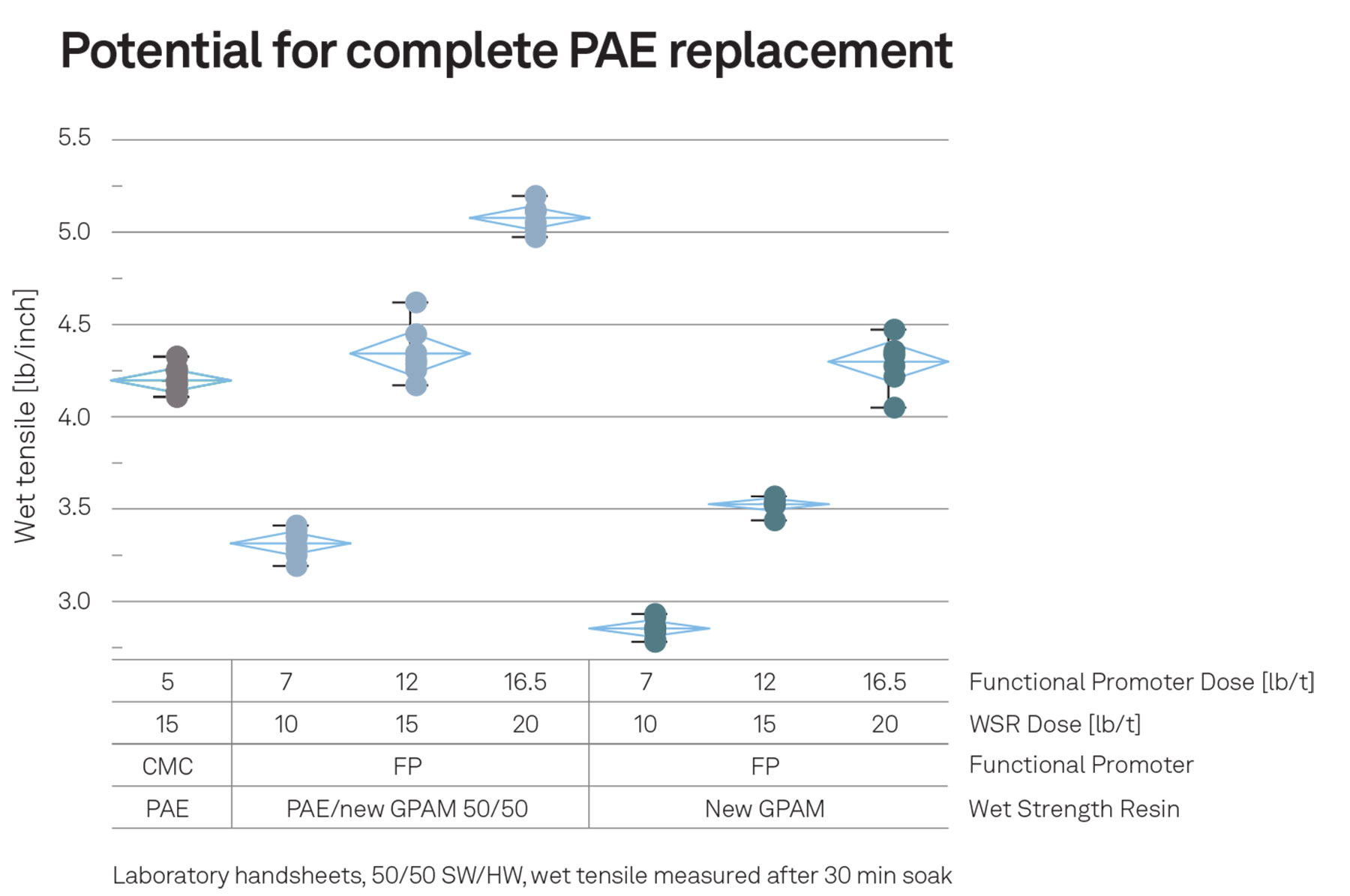
Kemira’s next-generation GPAM technology for tissue and towel production changes the game. Advances in polymer design have enabled novel GPAM based systems that resist hydrolysis more effectively and deliver sustained wet strength performance. The result is a decay profile that approaches that of PAE, 10–20% strength loss after a 30 min soak. When combined with a specifically designed anionic functional promoter (FP), the decay rate can be further reduced, and the GPAM system can deliver permanent wet strength behaviour that matches conventional PAE programmes with similar or lower wet strength chemistry dosages. This novel technology is patent pending.
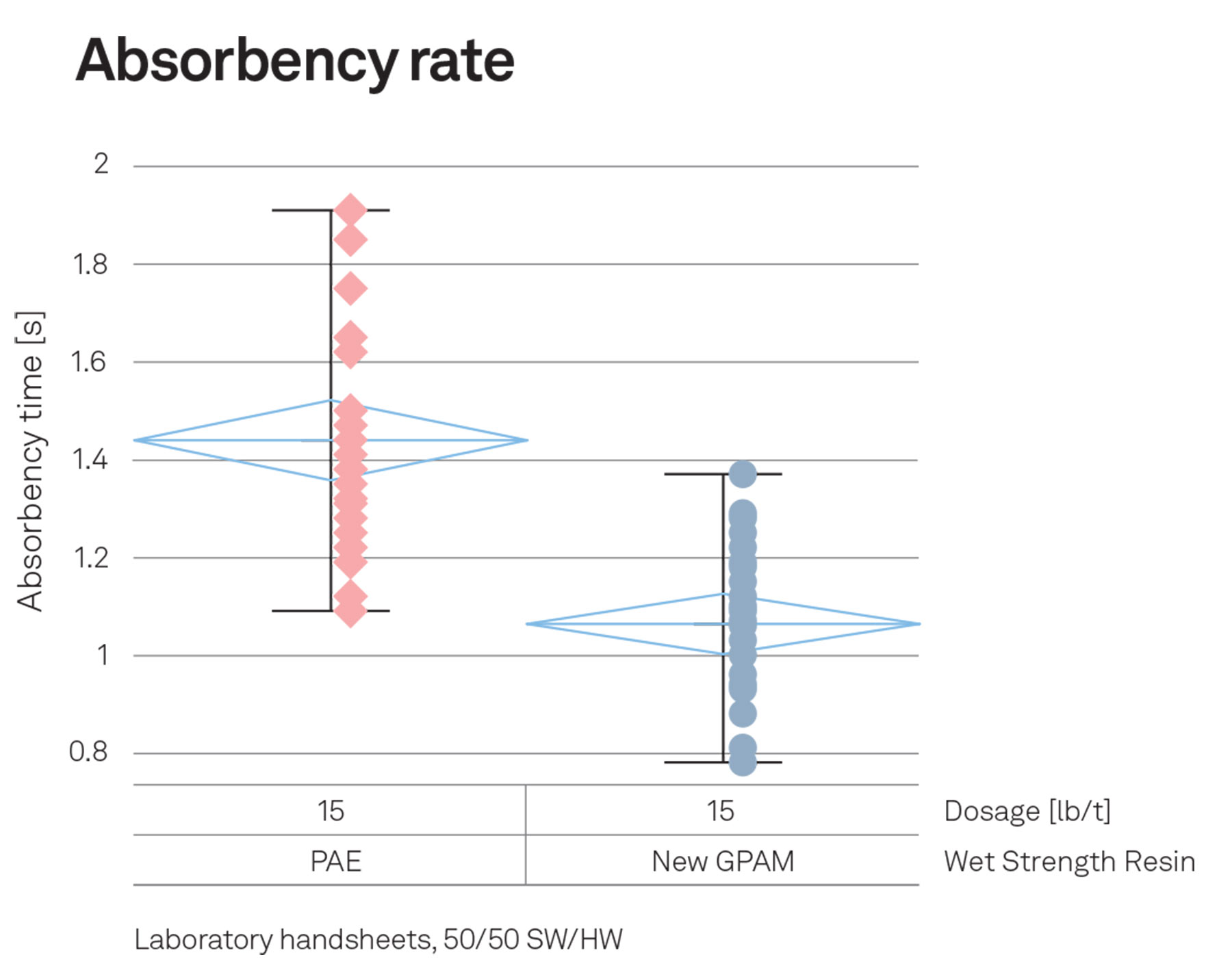
Beyond permanent wet strength performance, the new GPAM system simultaneously addresses the limitations of conventional wet strength chemistries. It helps improve the absorbency rate, which matters for both end-use performance and for how consumers perceive a towel product. Studies on virgin fibre handsheets showed 25% faster absorbency rates compared to PAE, and an industrial trial on RCF towel grade confirmed a 33% improvement.
In addition, the novel GPAM technology supports dry strength development, which reduces refining demand. And because GPAM operates at lower cationic charge than PAE, the overcationisation risk that contributes to runnability problems is substantially reduced. Repulping efficiency improves as well. Laboratory studies have confirmed that handsheets treated with the new GPAM repulp significantly more easily than those made with PAE resin.
The absence of epichlorohydrin-derived by-products removes the long-standing regulatory concerns. The technology is compatible with conventional wet-end addition points, which means implementation does not require any significant process changes.
Industrial cases: cost-efficient PAE replacement
The technology has been validated in industrial trials on both brown and white AfH towel grades. Two cases illustrate how the programme can reduce the cost of the wet strength programme while maintaining and, in some areas, improving product quality and machine performance.
Case study 1: 76% reduction in PAE dosages
The first case involved a tissue machine producing recycled brown towel from a furnish of approximately 80% OCC and 20% mixed office waste. The customer’s objective was straightforward: reduce strength programme cost without sacrificing product performance. Earlier trials with conventional GPAM chemistry had enabled only limited PAE substitution, capped at around 30%, before performance was impacted. Kemira’s next-generation GPAM changed the equation, delivering wet strength performance with additional operational and product quality benefits.
- PAE dosage reduced from 6.25 to 1.5 lb/ton — a 76% reduction
- Wet strength targets maintained throughout
Additional benefits:
- First-pass retention increased by 10–15%
- Refining energy demand dropped by 15%
- Absorbency rate significantly improved, decreasing from 90 seconds to 60 sec.
The combined impact estimated at $450,000 annual savings
Case study 2: Strength programme cost reduction
The results were consistent in a second industrial trial, this time a crescent former machine producing both white and brown AfH towel from recycled fibre, with an existing PAE programme running at 7.5–10 lb/ton. Again, the mill’s goal was to reduce the cost of the strength programme. Kemira introduced the new GPAM system with similar benefits.
- PAE dosage reduced by 50–65%
- Wet strength targets maintained throughout
Additional benefits:
- First-pass retention improved by 10%
- Refining power dropped by 10%
The overall annual cost savings amounted to $320,000.
Conclusion: A practical alternative to PAE
These results demonstrate that the industry’s long-held assumption about GPAM needs revisiting. Kemira’s advanced GPAM wet strength technology offers a differentiated alternative to conventional PAE programmes, providing permanent wet strength while simultaneously addressing the operational and sustainability limitations that have made PAE increasingly difficult to justify.
For towel producers facing cost pressure, sustainability targets, or runnability challenges linked to PAE programmes, this represents a practical path forward.
Acknowledgements
The author gratefully acknowledges the contributions of Junhua Chen for laboratory data and Matthew Turner for machine case studies.