














As source-to-shelf challenges become ever more demanding, longer-term planning must replace isolated interventions. William Nelson, President of E80 Group North America, explains why performance depends on designing the whole system, not simply selecting its individual parts.
A TWM report.
The most expensive automation decision is not necessarily the one with the largest initial investment. It may be the one that solves today’s problem perfectly and prevents the operation from adapting to tomorrow’s needs. Tissue manufacturers know that their plants will not stand still: volumes change, product formats multiply, new converting or packaging lines are added depending on market needs, warehouses need to be flexible and expand. At the same time, service and continuity are non-negotiable: production, storage, and shipping must operate as one uninterrupted flow.
Yet many intralogistics projects are still approached as isolated interventions, such as a vehicle fleet selected to perform one task from A to B, a palletiser added to one line, a warehouse designed around current volumes. Each investment may perform well on its own, but tissue operations do not behave like a collection of unrelated islands. A decision made at one point in the flow affects every process upstream and downstream.
Technology alone does not solve complexity. The companies that obtain lasting value from automation are those that begin with a clear end-state design, choose technology that can evolve within that design, and support the complete system throughout its lifecycle.
Design the system before selecting the single solution
A future-ready intralogistics project starts with a simple question: “What must the operation be capable of doing five, ten, fifteen years from now?”
The answer requires a detailed understanding of the business, the specific goals of the plant, and the possible ways this may change.
For a greenfield facility, this means establishing the desired end state before individual investments are approved. For an existing plant, it means understanding current constraints without allowing those constraints to define the future. In both cases, the process begins with data: throughput, SKU profiles, seasonal peaks, storage requirements, labour needs, material movements, production schedules, and service levels.
The next step is to translate those inputs into an operating concept. How should parent rolls move from storage to converting? How will packaging materials reach the lines? Where will finished pallets go? Which storage method best fits the product mix and available space? How will orders be prepared and trailers loaded? Where do manual operations remain appropriate, and where will they create a bottleneck or safety risk as volumes grow?
These questions need to be addressed together, to establish a roadmap in which every phase contributes to the same long-term system. A mill may automate finished-goods handling first and address raw materials later or expand its warehouse before introducing automatic trailer loading. Phasing is entirely reasonable; fragmentation has a high cost.
At this stage simulation technology is essential because it allows the project team to test decisions before committing capital. Multiple scenarios can show how a proposed design responds to higher volumes, a different SKU mix, additional production lines, altered shifts, or new warehouse requirements. E80 Group’s discrete-event simulation approach can validate expected system performance with up to 95% accuracy. More importantly, it exposes interactions that are difficult to see when each technology is evaluated separately. This is where automation begins to deliver value before the first machine is installed: it helps test assumptions and supports investment decisions, giving the companies a scalable and flexible plan for reaching a defined operational goal.
Build on an integrated and flexible technology foundation
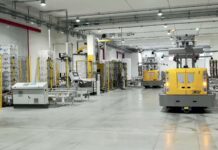
Once the operating concept is clear, the technology must serve it. A tissue plant may need robotic palletisers, stretch wrappers, labellers, laser-guided vehicles, parent-roll handling systems, block storage, drive-in racking, or an automated high-bay warehouse. The specific combination varies, but the principle remains the same: each asset should function as part of one coordinated environment.
The decisive layer is software. Hardware performs the movements, while software determines what should move, when, where, and with what priority. E80 Group’s proprietary software platform connects production systems, automated equipment, warehouse operations, and the customer’s ERP, it coordinates demands in real time, manages traffic, maintains traceability, and provides one view of system performance from receiving through shipping.
This approach is based on a security-and-safety by design framework: our solutions comply with international standards and regulations and integrate advanced technologies that work together as complementary safety layers to help reduce risks arising from unpredictable behaviours. In highly interconnected ecosystems, cybersecurity measures further strengthen protection of data and industrial systems, supporting operational continuity.
This common foundation also makes expansion more practical as new vehicles, production lines, storage capacity, or functions can be incorporated in a second stage without creating a new control island every time the plant changes. Different generations of equipment can coexist, and existing assets can take on new tasks through revised logic rather than wholesale replacement.
The benefit is operational predictability: when the complete flow is coordinated, the plant can reduce manual handling, enable people to focus on tasks where human judgement adds greater value, respond more consistently to production demand, and measure performance against meaningful system-wide KPIs. Accountability also becomes clearer: there is one system outcome to manage, not a series of disconnected equipment results.
Plan for the lifecycle, not only the go-live
A successful start-up is important, but it is not the final measure of an automation project: as we experienced with many long-term projects, the real test begins after the go-live, when the system encounters changing demand, new operating requirements, component obsolescence: industrial automation should be designed to operate for decades. That requires durable equipment, continuity across product generations, and a deliberate strategy for updates. E80 Group’s laser-guided vehicle systems regularly remain in operation for 15 years or more. Their useful life is supported by vertically integrated design, retrofit options, and the ability to run multiple generations within the same fleet – this allows customers to expand or replace assets gradually instead of disrupting the entire operation.
Software extends that life even further because it allows continuous optimisation and preventive maintenance. Furthermore, regular audits can identify wear, usage patterns, and future availability risks early enough to schedule interventions and budget for them. Planned modernisation changes the meaning of service: while reactive support focuses on individual assets and fixes what breaks, lifecycle support manages the performance of the complete system. It combines Service Level Agreements, defined KPIs, continuous monitoring, remote and on-site technical support, training, spare-parts planning, software updates, and periodic optimisation.
The distinction is crucial: reactive service may protect equipment, while integrated lifecycle service protects throughput and continuity, and it also creates a single line of accountability; one partner is responsible for understanding how the parts interact and for helping the system continue to meet its performance objectives.
A long-term performance
Automation projects are often compared through the fastest payback calculation. Payback matters, but speed alone is a poor measure of a system intended to serve the plant for many years. A lower-cost intervention can become expensive if it restricts expansion, requires repeated integration work, depends on unsupported components, or forces premature replacement.
Long-term ROI should include uptime, predictable throughput, deferred capital expenditure, reduced product damage, safer material flows, more efficient use of space and energy, and the ability to respond to business change without redesigning the plant from the beginning. Extending the life of equipment also reduces scrapped components and avoids unnecessary replacement.
We can’t predict the future – no one can know exactly what its product mix or distribution model will look like fifteen years from now – but we can build the capacity to respond: a validated roadmap, an integrated control architecture, scalable equipment, measurable performance, and a service model that improves the system over time. For tissue decision makers, the question is therefore no longer simply, “What should we automate?” but, also, “What kind of operation are we building, and will today’s decisions allow it to keep evolving?” When design, technology, and lifecycle support are considered together, automation does more than solve a current constraint: it gives the plant room to grow.