

















By European-headquartered eucalyptus pulp production company Ence’s Vitor Batistela, Fluff Product Development Expert, Clara Orozco, Fluff Product Development Technician, Juan Luna, Fluff Product Development Manager, and María Peón, Technical Director of Commercial Area.

The global fluff pulp market continues to expand, mainly driven by growing demand in adult incontinence products, feminine hygiene, airlaid substrates, medical absorbents and pet-care applications. Historically, this market has been dominated by long-fibre softwood kraft fluff pulp, particularly from North America. However, eucalyptus-based fluff pulp is increasingly emerging as a technically and commercially relevant segment.
Publicly available data indicate that global fluff pulp capacity reached around 7.8m air-dried tons per year in 2024, including swing capacity. Under a central demand scenario, consumption is expected to grow from approximately 7.5m tons in 2025 to nearly 8.9m tons by 2030. Although eucalyptus fluff still represents a minority share, it is clearly transitioning from niche or pilot-scale developments into industrial-scale production.
In this context, new capacity additions are shaping the segment, including Ence’s entry into the market with a 125,000tpy eucalyptus fluff pulp line at its Navia biofactory in Spain, focused on supplying the European absorbent hygiene market. Based on publicly announced projects, total eucalyptus fluff capacity could reach around 565,000tpy from 2026 onwards, representing roughly 6–7% of the global market. This evolution opens a strategic opportunity, particularly in Europe, to partially substitute imported long-fibre fluff while benefiting from advantages in softness, compression, rewet performance and overall product design flexibility.
In parallel, eucalyptus fluff pulp has gained increasing relevance in absorbent applications, supported by the development of different species and production approaches. Among them, Iberian Eucalyptus, stands out due to its unique chemical composition and fibre morphology. These intrinsic characteristics enable new approaches to improving performance in hygiene and absorbent products.
Building on a strong background in sustainable forest management and pulp production, Ence has developed extensive expertise in the cultivation and processing of Iberian Eucalyptus. The species, widely recognised for its favorable chemical and morphological profile, allow the production of a fluff pulp that combines good core integrity, softness and reliable liquid management properties. As a result, it is particularly well suited for applications such as feminine care, baby diapers, adult incontinence products, absorbent pads, airlaid and other innovative absorbent solutions.
By combining high-quality raw material, optimised process conditions, product development and dedicated technical support, traditional limitations often associated with hardwood fibres in absorbent products can be effectively addressed. This positioning allows Iberian Eucalyptus based fluff pulp to act as a competitive and sustainable alternative, capable of delivering performance aligned with the requirements of modern absorbent product designs.
This article explores the key elements behind this evolution, including wood chemistry, fibre morphology and application-driven development, highlighting how customer-focused solutions are enabling the expansion of eucalyptus-based fluff across hygiene, specialty and next-generation absorbent products.
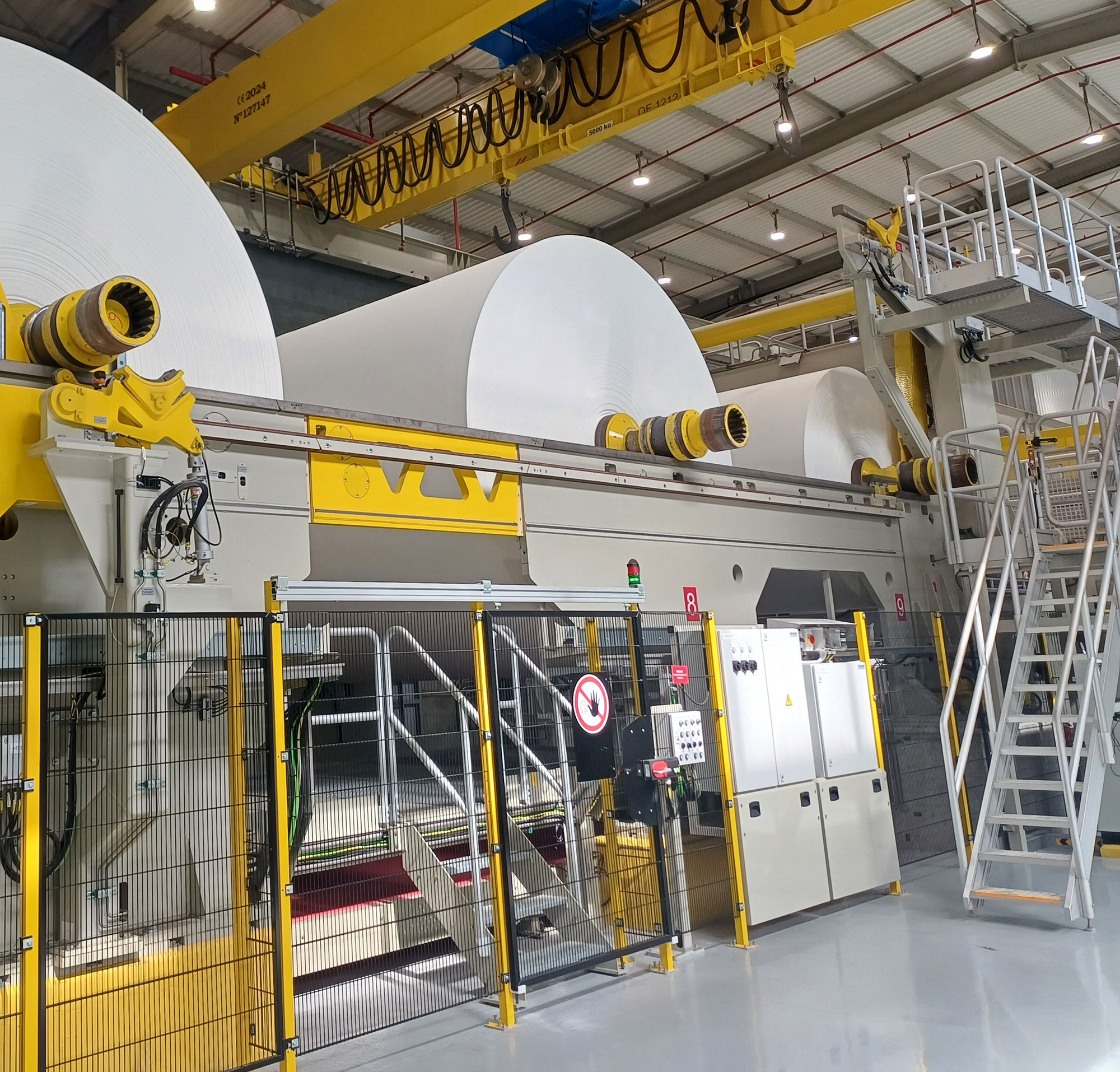
Leaff is an Iberian eucalyptus-based fluff pulp developed by Ence after years of research and innovation. Traditionally recognised for its broad portfolio of specialised eucalyptus grades for papermaking, Ence has leveraged its deep expertise in raw material selection and process optimisation to create a high-quality fluff pulp tailored for absorbent applications. By combining selected Iberian Eucalyptus resources with advanced processing know-how, Leaff delivers consistent performance and is suitable for a wide range of conventional and emerging uses.
In general, eucalyptus pulps are known for contributing valuable properties to paper and fibre-based products, including good drainability, high porosity, elevated bulk, and stiffness, as well as distinct opacity. They also enable superior formation, smoothness, and printability, offering a well-balanced combination of strength and structural properties alongside bulk and optical performance.
However, not all bleached eucalyptus kraft pulps (BEKP) are the same. Important differences arise depending on wood-related factors, such as species, clone, age, and growing conditions, as well as on processing parameters. These variations are primarily reflected in fibre characteristics, including length and distribution, coarseness, wall thickness, fines content, vessel presence, and hemicellulose levels. Such attributes ultimately define the performance of the pulp in both paper and absorbent applications.
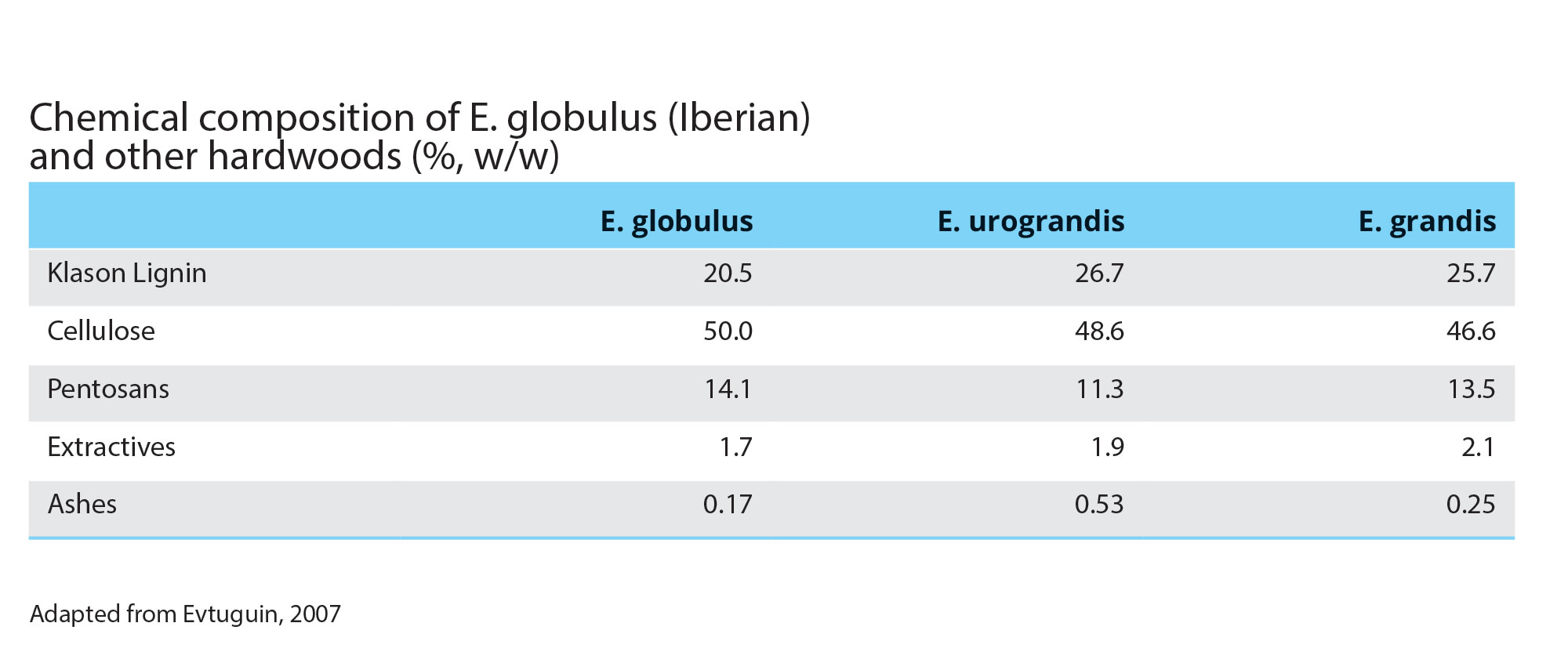
When comparing Iberian Eucalyptus with species such as E. urograndis and E. grandis, which are widely planted in South America, important differences emerge from a chemical perspective. The higher pentosan content, representing a significant portion of hemicelluloses, plays a key role in enhancing mechanical properties. This contributes to stronger interfibrillar bonding, resulting in greater core integrity, and promotes increased water retention within the fibre, reducing fluid return to the surface (lower rewet), which helps minimize leak occurrence and improve skin dryness, lowering the likelihood of dermatitis for the end user.
At the same time, the naturally lower content of lignin and extractives in Iberian Eucalyptus supports better brightness stability and helps prevent hydrophobic effects that can negatively impact liquid absorption. From a chemical standpoint, these characteristics make Iberian Eucalyptus particularly well suited to meet the demanding requirements of absorbent product applications.


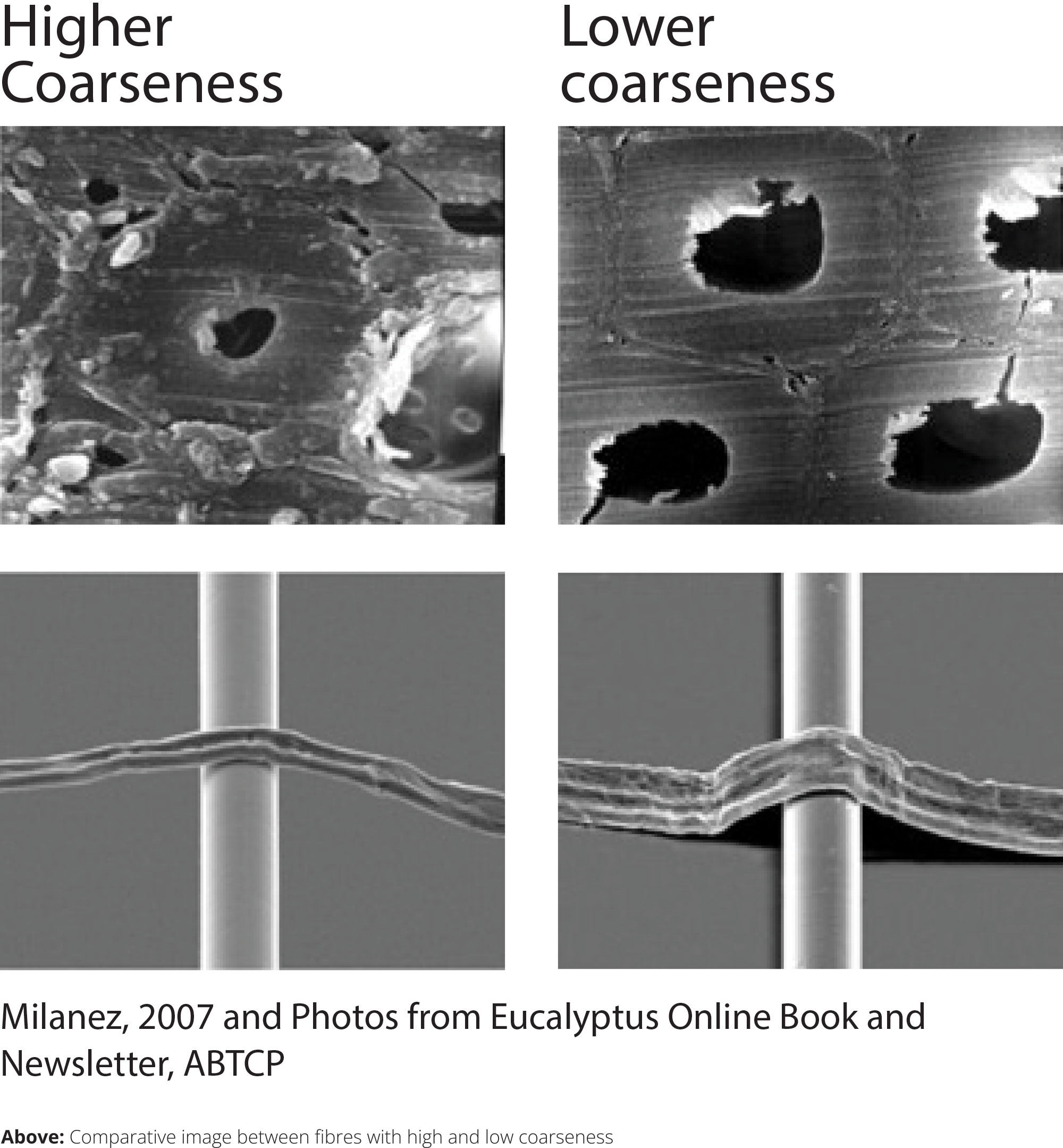
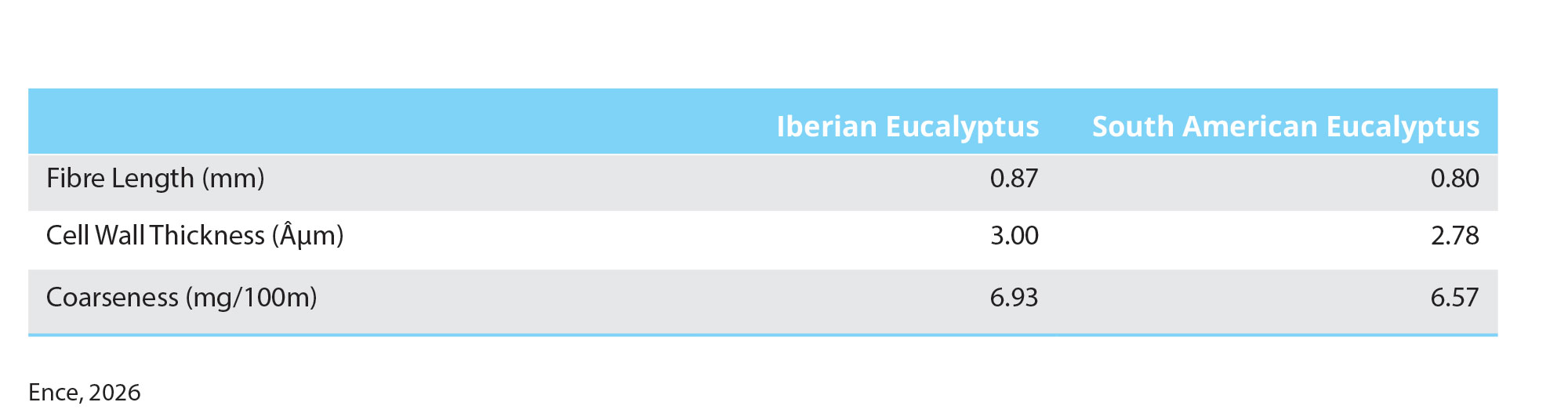
From a morphological perspective, Iberian Eucalyptus fibres tend to present slightly greater length, along with higher cell wall thickness and coarseness. These features make the fibres stiffer, which enhances fibre entanglement and contributes further to mechanical strength. Additionally, this structural configuration promotes the formation of more resilient and open void spaces within the fibre network, improving both absorption capacity and liquid acquisition speed.
Launched in August 2025, Leaff has already been tested and regularly used in a broad range of absorbent applications, often requiring only minor, or in some cases no, adjustments to producers’ converting lines to achieve premium end products within expected quality requirements. Its application potential has been demonstrated across different segments, including feminine hygiene products, underpads, adult incontinence diapers, baby diapers and airlaid structures.
As an Iberian eucalyptus-based fluff pulp, Leaff brings a different fibre concept to a market traditionally dominated by softwood fluff. This difference naturally raises technical questions among producers looking for alternatives to long-fibre supply, particularly regarding sheet density, defibration behavior and absorption performance. A frequent concern is whether eucalyptus fibres necessarily lead to denser fluff sheets, making them more difficult to process or less efficient in absorbent cores. In practice, the answer depends not only on fibre morphology, but also on pulp sheet design, production technology, defibration conditions, and the overall absorbent product architecture.
In the case of Leaff, the combination of selected Iberian eucalyptus raw material and dedicated production technology allows the product to reach a sheet structure that is comparable to the main market references. Its higher sheet thickness, associated with low density and suitable fibre morphology, results in lower Mullen values when compared with long fibre references. This reduced burst resistance is particularly relevant because it favors easier defibration, while maintaining the capillary properties required for efficient fluid management in absorbent products.
This balance between sheet structure and mechanical resistance has a direct impact on fibreisation quality and energy consumption during processing, whether in sawmill or hammermill systems. A sheet that is easier to open tends to reduce the mechanical effort required during defibration, supporting more stable operation and potentially lower energy demand. At the same time, proper fibre opening is essential to ensure homogeneous pad formation, good fibre distribution, and consistent performance in the final absorbent core.
At laboratory defibration scale, Leaff has shown comparable fibreisation quality, indicating that eucalyptus-based fluff can be effectively opened under controlled conditions. However, laboratory results should be understood as a useful comparative reference, rather than a complete representation of industrial performance. In real production environments, the operational setup of the defibrator has a direct influence on fibreisation efficiency and, consequently, on absorption behavior, pad strength, and core stability.
Key parameters such as rotor speed, breaking bar gap, screen opening (when applicable) and feeding conditions can significantly affect the final fibre network. When these parameters are properly adjusted, they can improve fibre separation, reduce fibre bundles, enhance pad uniformity, and increase the effective use of the fibre’s intrinsic properties. This was observed in a real case where the original defibration condition was optimized, leading to substantial improvements in several performance indicators.
From an absorption standpoint, it is important to recognise that eucalyptus fibres may present some limitations when directly compared with traditional long fibre fluff, especially in terms of total absorption capacity and acquisition time. The shorter fibre length and different network structure can influence liquid intake dynamics and the volume of open voids available in the absorbent matrix. Therefore, if evaluated in isolation, eucalyptus fluff may show lower absorption capacity or slower acquisition speed than softwood-based references. However, absorbent product performance is not determined by fluff pulp alone. It is the result of a complete system, where fibre properties interact with the design of the core and with other materials such as nonwovens, acquisition and distribution layers, SAP type and dosage, embossing pattern, core channels, tissue layers, and overall pad geometry. When these elements are correctly selected and combined with well-adjusted process parameters, the potential differences in absorption capacity and time can be significantly reduced, or even fully compensated.
This has been demonstrated in underpad testing, where Leaff-based structures achieved absorption capacity equivalent to long fibre references when incorporated into an optimized product design. The result confirms that, with the right combination of raw materials and converting parameters, eucalyptus fluff can deliver the required performance for demanding absorbent applications.
Another relevant advantage of Leaff is its positive contribution to rewet performance. Due to the chemical and morphological characteristics of Iberian Eucalyptus, particularly its hemicellulose profile and water retention behavior, the fibre can help reduce liquid return to the surface after absorption. Lower rewet means improved skin dryness, which is especially important in hygiene applications where comfort, leakage prevention, and skin health are critical quality attributes. In this sense, Leaff can provide a meaningful benefit in liquid retention and surface dryness.
The improved defibration study further reinforces this point. By adjusting the operating conditions of the defibrator, it was possible not only to improve fibreisation quality, but also to enhance several end-product properties. Better fibre opening contributed to more uniform pad formation, improved mechanical stability, and more efficient liquid handling.
These results highlight that the full potential of Leaff is achieved when pulp characteristics, equipment setup, and product design are treated as an integrated system rather than as independent variables.
For this reason, specialised technical assistance plays an important role in accelerating the implementation of Leaff at customer sites. Each production line has its own configuration, limitations, and opportunities for optimisation. By supporting customers in the adjustment of defibration parameters, material combinations, and product design, Ence can help maximise operational performance and final product quality. This approach improves absorbent product performance and also contributes to higher process efficiency, better raw material utilisation, and potential financial advantages.
Overall, Leaff demonstrates that eucalyptus-based fluff pulp can be successfully applied in absorbent products when supported by the right technology and process know-how. While some absorption parameters may naturally differ from long fibre fluff, these differences can be managed through formulation, design, and operational optimisation. At the same time, its favourable defibration behaviour, good pad integrity contribution, and rewet advantages position Leaff as a competitive and sustainable alternative for the next generation of absorbent products.
This article was written for TWM by Ence’s Vitor Batistela, Fluff Product Development Expert, Clara Orozco, Fluff Product Development Technician, Juan Luna, Fluff Product Development Manager, and María Peón, Technical Director of Commercial Area.