
















Premium products key by combining convenience, versatility and value delivered in a highly developed e-commerce infrastructure. Report by Euromonitor International Consultant Per Brandberg.

South Korea’s retail tissue market continued to demonstrate resilience, recording current value growth of 1% to reach KRW1.7tn. While growth remained modest, the category benefited from the essential nature of tissue products, the continued dominance of e-commerce, and rising consumer demand for premium and sustainable offerings. However, brands are operating in an increasingly challenging environment shaped by demographic decline, population ageing, and intensifying competition from private label and value-oriented alternatives.
Premiumisation offsets pricing pressures and natural materials drive innovation
The market’s performance was largely driven by ongoing premiumisation efforts from leading manufacturers. At the same time, the growing presence of private label products and competitively priced online offerings continued to place downward pressure on unit prices and reshape consumer perceptions of value.
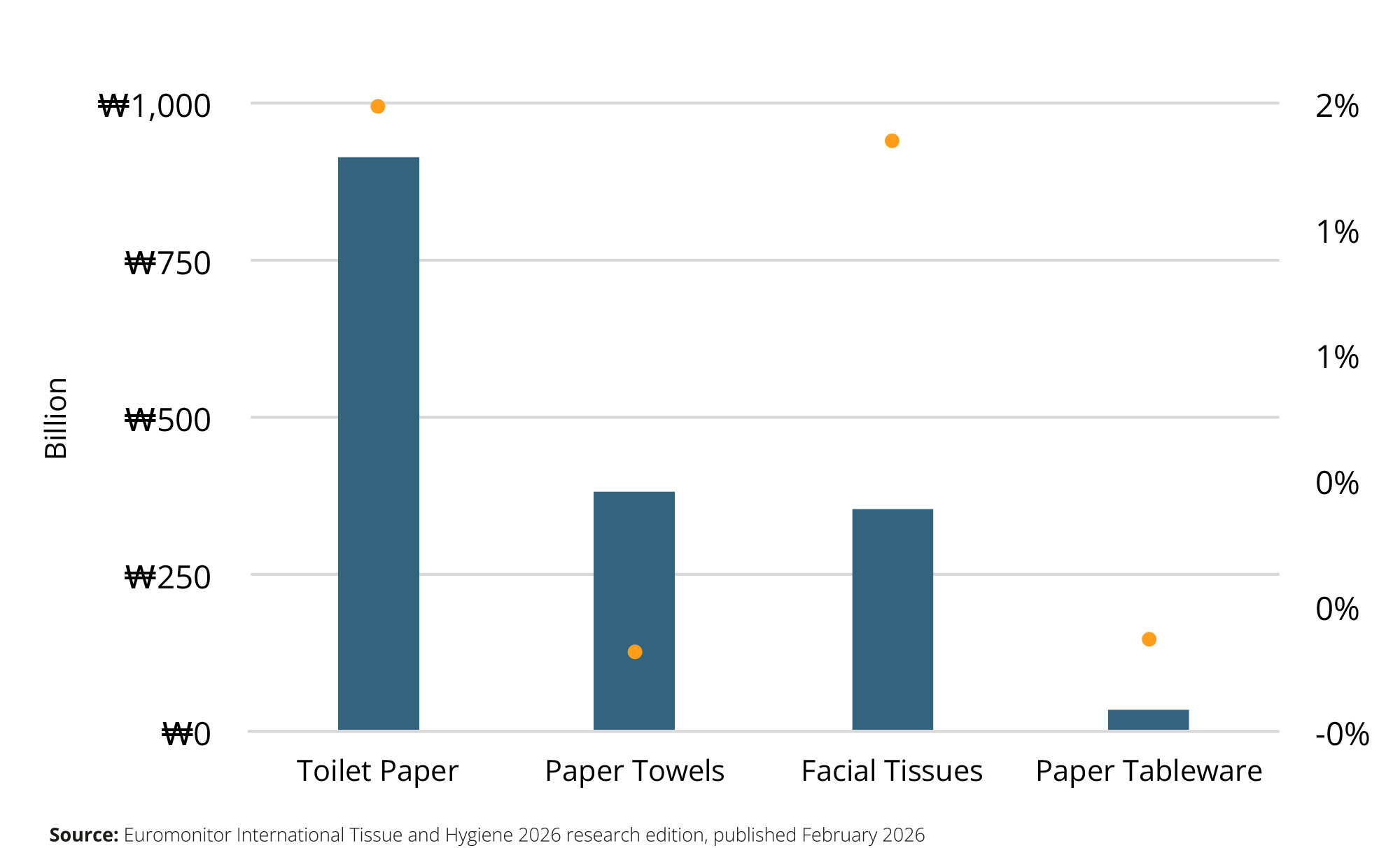
Toilet paper emerged as the strongest-performing category in 2025, growing by 2% to reach KRW915bn. Its success reflects both its status as an everyday necessity and changing consumer shopping habits. South Koreans are increasingly looking for purchases around products that offer greater convenience and versatility, such as premium toilet tissues and interleaf kitchen towels. This trend is particularly evident among urban consumers living in smaller households and managing busy lifestyles.
The second largest retail tissue category, paper towels, continued to struggle in 2025, however the pace of decline moderated significantly. Current value sales fell by just 0.2% to KRW384bn, compared with a 2% decline in 2024. Within the category, however, interleaf or pull-out formats are gaining momentum. These products offer hygienic single-sheet dispensing, ease of use and improved space efficiency, attributes that increasingly resonate with consumers seeking practical solutions for modern households. Consumer interest is clearly reflected in sales performance. According to Daiso Mall’s year-end report, its Living Pull-Out Kitchen Towel achieved a 30% reorder rate, highlighting strong demand for products that combine convenience, versatility and value.
One of the most notable developments in 2025 was the growing use of natural materials in premium tissue products. Bamboo pulp especially has gained traction as brands seek to appeal to increasingly health-conscious and environmentally aware consumers. KleanNara’s partnership with Vastley led to the expansion of its Better range, which includes bamboo-based facial tissues, reusable kitchen cloths and compressed towels. The line targets ingredient-conscious consumers through features such as unbleached bamboo pulp and lotion-infused tissues. The bamboo lotion tissue, containing 25% lotion, received an “excellent” rating from Germany’s Dermatest, reinforcing its premium positioning. The products’ ecofriendly, hypoallergenic and sustainable credentials enable brands to justify higher price points in an increasingly competitive market.
Looking at the market, other manufacturers are following a similar path. Monalisa, for example, has expanded its bamboo-based portfolio with natural, unbleached and fragrance-free pull-out kitchen towels. These innovations align closely with South Korea’s changing demographic profile, as a growing proportion of older consumers seek products that emphasise health, safety and convenience.
Market leaders face growing competitive pressure
Retail tissue remained moderately concentrated in 2025, although the market is moving toward being more fragmented than in previous years. Yuhan Kimberly retained the leading position with a 29% value share, supported largely by its Kleenex brand, which accounted for 28% of total brand sales. However, the company has experienced a notable decline in market share over the review period, falling from 35% in 2020. In contrast, KleanNara increased its share from 12% to 15% over the same period.
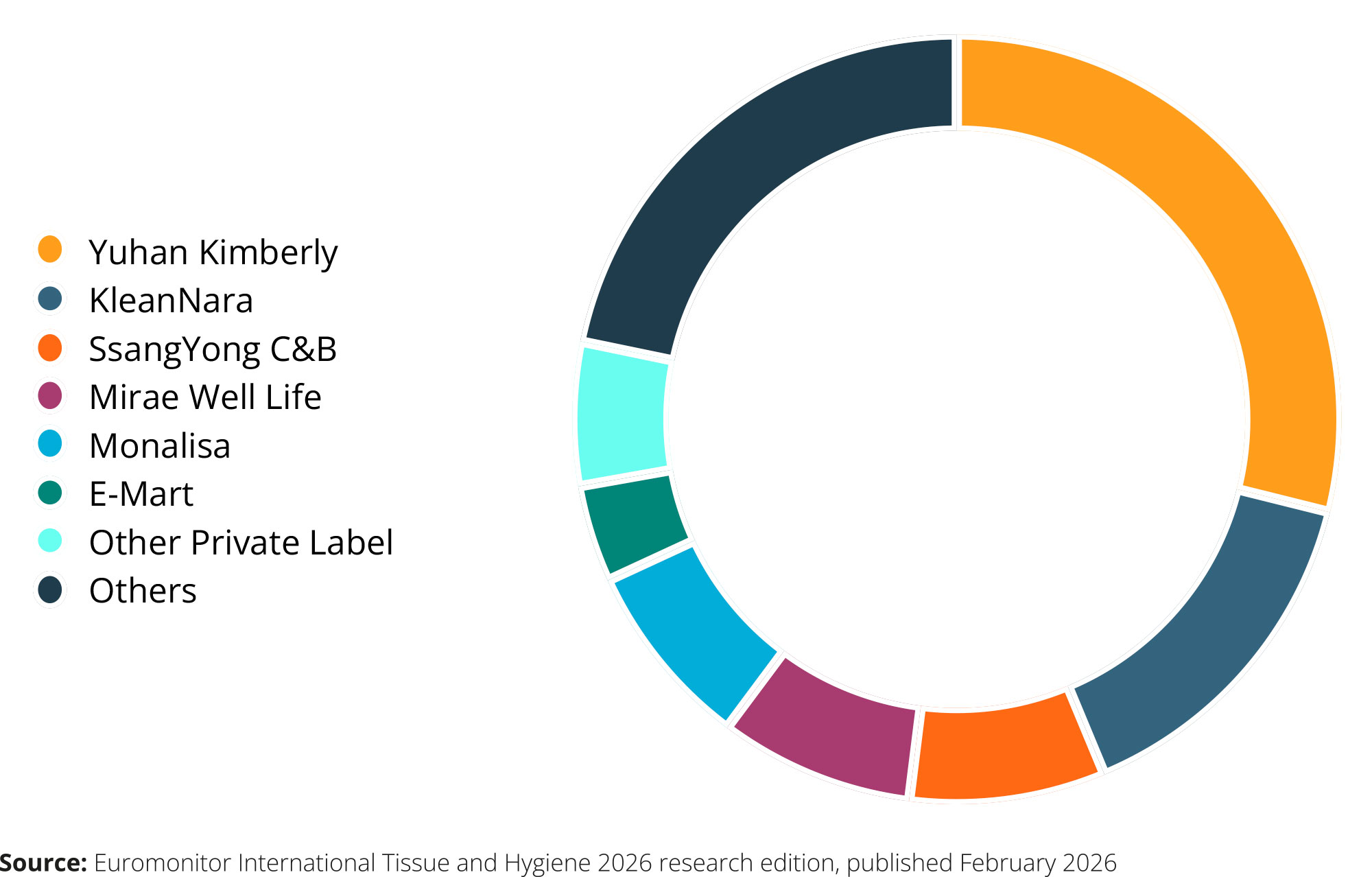
The erosion of Yuhan Kimberly’s position highlights the growing influence of private label products and smaller value-focused brands. This trend is especially visible in toilet paper, where low brand loyalty and the product’s essential nature encourage consumers to prioritise price over brand names.
Private label continues to gain importance across the category. E-Mart accounted for 4% of retail tissue sales in 2025, while other private label brands collectively represented 10%. Smaller independent brands captured a significant 18% share of the market. Together, these players are steadily cannibalising share from category leaders and intensifying competition across all retail tissue segments.
E-commerce continues to reshape the market
South Korea’s highly developed e-commerce infrastructure remains one of the defining characteristics of the retail tissue market. In 2025, online sales accounted for 78% of total category value, making e-commerce by far the dominant distribution channel. Consumers continue to embrace the convenience of next-day delivery and the ability to purchase bulky tissue products without transporting them from stores. The extensive availability of competitively priced private label offerings on platforms such as Coupang and E-Mart further reinforces the attractiveness of online shopping. Although offline channels remain relevant, their role has diminished significantly. Offline retail accounted for just 22% of retail tissue sales in 2025, down from 46% in 2020. Hypermarkets and warehouse clubs continue to attract family shoppers and consumers purchasing in bulk, together representing 19% of category value sales. Nevertheless, these channels continue to lose share as e-commerce strengthens its hold on consumer purchasing habits.
Outlook: slow growth, stronger premiumisation
Looking ahead, South Korea’s retail tissue market is expected to maintain low but positive growth in the forecast period. Category value is forecast to reach KRW1.8 trillion by 2030, representing a CAGR of 1%. Growth will be constrained by the country’s declining population, which is expected to fall from 52m in 2025 to 51m by 2030, alongside ongoing population ageing. As a result, manufacturers are increasingly prioritising value creation rather than volume expansion.
Functional premiumisation is expected to continue to be the key growth strategy. Brands are likely to focus on fluorescent-free, fragrance-free and colour-free formulations, environmentally conscious positioning, lotion-infused products and formats designed specifically for smaller households. These features help reduce direct price comparisons and create meaningful differentiation from private label alternatives.
Toilet paper is projected to remain the category’s primary growth engine, achieving a current value CAGR of 2% and reaching KRW993.5bn by 2030. Growth will be supported by the products role as an everyday necessity, as well as ongoing consumer interest in premium and multifunctional products, with improvements in softness, absorption and functionality increasingly blurring the boundaries between tissue categories. In an environment characterised by demographic headwinds, heightened price sensitivity and expanding private label competition, success will depend on brands’ ability to deliver innovation, convenience and tangible product benefits that justify premium positioning.