


















José González, Director – AFRY Management Consulting
Summary: Innovation in the tissue industry is about making disciplined choices on where to invest, as the market grows but becomes more competitive, global, and constrained by rising capacity, cost pressures, and sustainability demands. Success depends on shifting volume to differentiated value and aligning product innovation, advanced manufacturing process and region-specific business models into a coherent strategy that balances efficiency, quality and sustainability. The real innovation challenge in tissue is where you place your bets…
“Innovation is not about better ideas. It’s about better ways of allocating resources”
From The Innovator’s Dilemma, Clayton Christensen
Global tissue market fundamentals
China is the world’s largest tissue market, accounting for 29% of global tissue consumption in 2025:
- Global Tissue Consumption 2025: 46.8m tons
- China – 29%
- North America – 20%
- Europe – 19%
- Other Asia – 12%
- Latin America – 10%
- Rest of World – 10%
(Notes: Europe excludes Russia and Belarus. Rest of World includes Africa, the Middle East, Oceania, Russia, and Belarus)
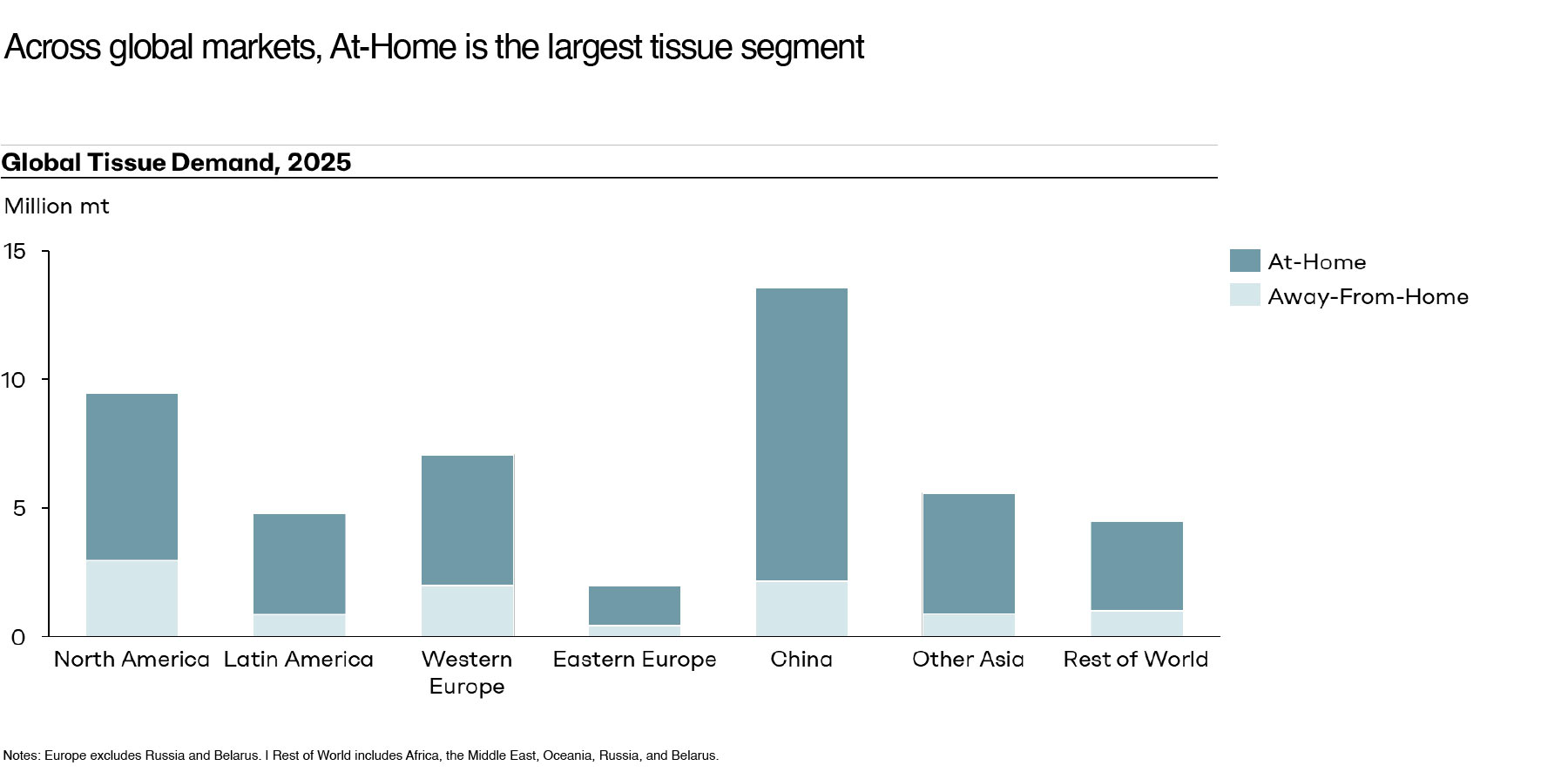
Across global markets, At-Home is the largest tissue segment
Per capita consumption is highest in North America, largely due to a higher use of disposable kitchen towels, and a large AfH segment.
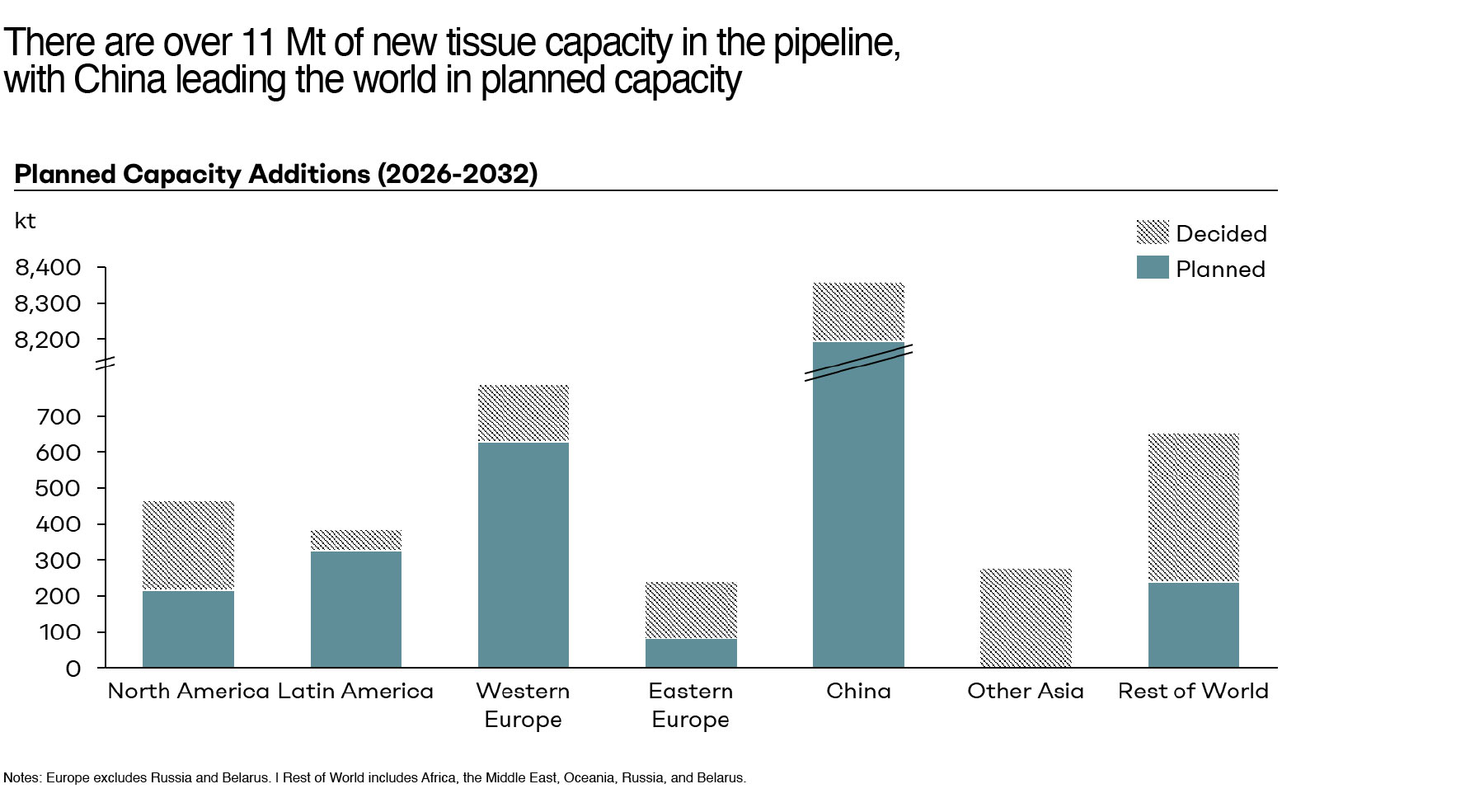
There are over 11m tons of new tissue capacity in the pipeline, with China leading the world in planned capacity
Today, producers sell a variety of products with different specs to meet specialised consumer preferences in diverse segments and geographies.
Consumer tissue: Packaging, format and size. Additives and decorative additions
AfH: High-capacity dispensers and efficiency improvements
This trend is also visible in the alternative fibre tissue product space, which aims to meet sustainability targets, while satisfying the wide range of consumer needs.

New technologies enable the next wave of innovation in tissue manufacturing
Manufacturing optimisation:
- Stainless steel use for Yankee machines
- Water – use reduction during press and formation processes while retaining bulk and structure
- New shoe press technologies
Energy Concept:
- Electrification and alternative fuels for boilers, including biofuels and hydrogen
- On-site BESS assets for mill operations to allow for hybrid energy concepts
Data Analytics:
- Incorporation of AI to provide additional process insight with complex custom trending and modelling options
- Predictive models for process behaviour and “soft sensors” for sheet properties, aided by new in – line instrumentation
Process control:
- Automated loop tuning and troubleshooting
Maintenance and Up-time:
Off-site and digital condition monitoring
‘Digital twins’ of key equipment and other digital tools for visibility of equipment condition
Technology – use around the world is shaped by the manufacturing environment, equipment availability, and consumer preference
North America: TAD technology allows for higher quality tissue production
Europe: European players focus on sustainable and cost-effective production methods and therefore use more conventional machines.
China: China has many local suppliers that do not disclose machine concepts, but typically operate smaller DCT machines.
Innovation looks different across global regions – however, one common factor across regions is a drive for digitization across all major manufacturing sites
North America: Innovation is largely driven by commercial considerations
- Highest consumption per capita
- Largest AfH sector
- Brands hold a strong position
- Quality standards are the highest
- TAD machines are com
Europe: Innovation is largely driven by cost of energy and fibre and environmental considerations
- Emergence of the “hybrid mill”: renewables, BESS, biofuel, hydrogen, electrification
- Reduction in water consumption, especially in water – stretched regions
- Emerging alternative fibre sourcing: LPB, OCC, straw, etc.
Asia: Innovation is largely driven by considerations
- Large, pulp – integrated sites emerging
- High Euca/hardwood penetration and prevalence of bamboo pulp
Variation in market maturity: Mature markets (e.g., Japan) vs. emerging markets (e.g., India)
E-commerce platforms are becoming more popular in some global regions; branded products are favoured on e-commerce platforms.
North America – Subscription models with scheduled, frequent deliveries are on the rise. North American companies mainly rely on traditional online retail and click – and – collect services
Europe – E-commerce has a minimal impact on the market. Europe has the largest private label market in the world. European consumers are aware that lowest price options may not be available through online channels
Asia – Consumer behaviour is driven by social commerce on platforms like TikTok and WeChat. Asia hosts the most dynamic online tissue market, as brands have adapted to be e-commerce – focused, with products available on multiple platforms.
Wrap up
Tissue remains a growth industry, led by China and AH consumption, but with rising capacity and cost pressure redefining what “competitive” means
Innovation is shifting from volume to differentiation with product formats, performance attributes, and sustainability now central to value creation
Process technology is entering a new wave where quality, efficiency, and decarbonisation must advance together, not sequentially
Business models diverge by region, yet digitisation, resource efficiency, and resilience are becoming universal requirements.
The winners will be those who connect market insight, technology choices, and operating models into a coherent innovative strategy.