
















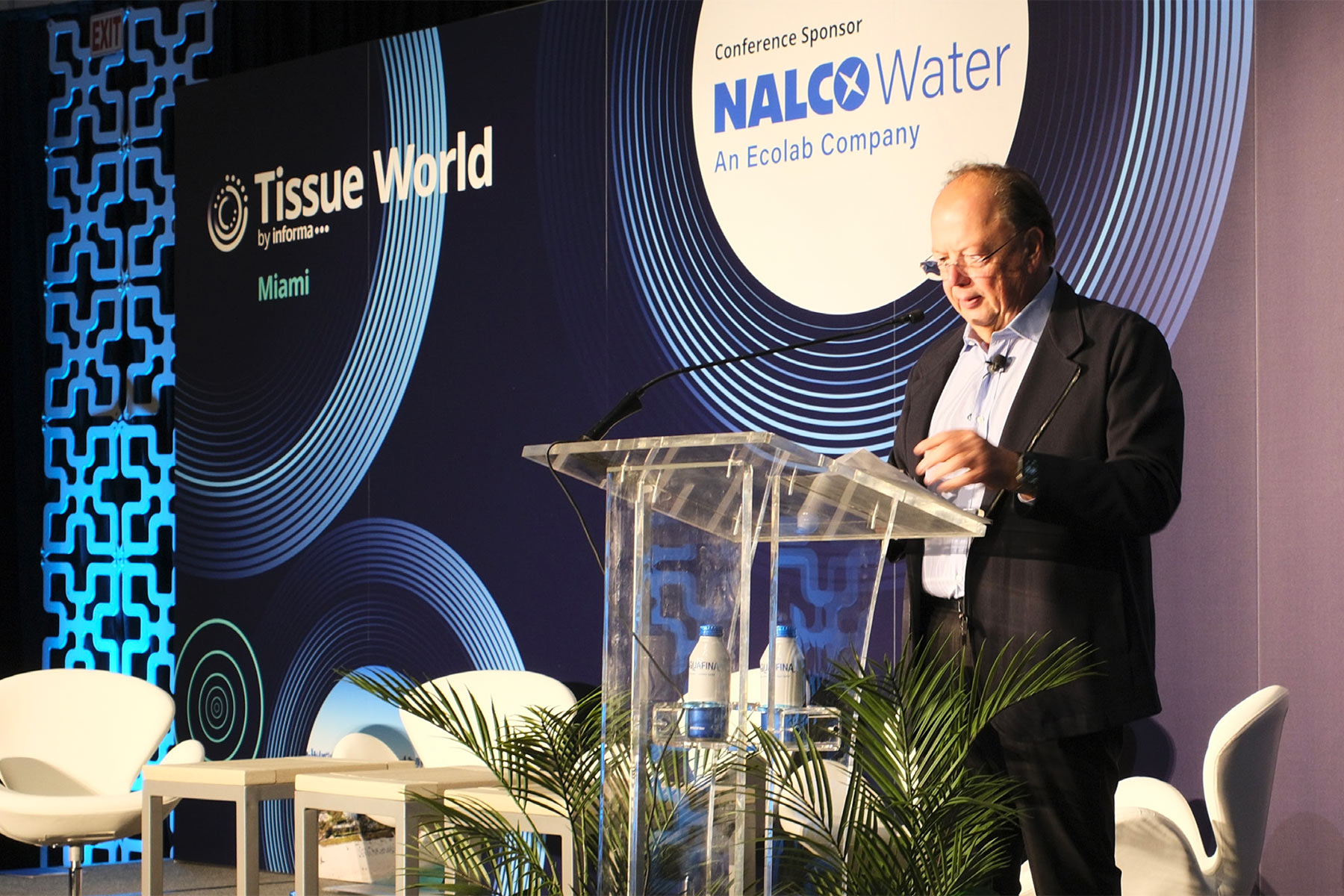
Luigi Lazzareschi, Chief Executive, Sofidel Group
The private label dilemma: a structural shift? Private label is rapidly gaining ground in the US tissue market. Is this a structural shift? Is it on track to reach European penetration levels?
THE AI’S TAKE
Here is the AI’s response:
‘Yes, the US tissue market is undergoing a structural shift. This shift is driven by changes in production ownership, consumer attitudes, and retailer strategies. And yes, private-label penetration is poised to rise strongly. While it may not reach European levels immediately, the trajectory clearly points toward a much higher share than historically seen in the United States.’
A view between Europe and the US
Private label is rapidly gaining ground in the US tissue market. Europe has been ahead on this curve for a long time. At Sofidel, we developed and grew precisely in those markets, where private label has long been structurally significant. That perspective is where I’d like to begin.
Back to the early 1980s: private label begins to grow in Europe
Early 1980s: Private label spread rapidly through major retail chains. Large companies overlooked the segment, despite its fast growth. Sofidel seized the opportunity, investing in modern converting plants and reaching, sometimes exceeding, multinational technology. Retailers valued the quality and volumes surged. A long journey started here.
What we learned from our European experience
The evolution of the European Private Label market showed us how important it is to:
- Get geographical coverage
- Invest in state-of-the-art technology
- Build a customer-centric strategy
- De-commoditise the product offering
- Premiumise the offering
Back to the 2010s: Sofidel moves to replicate its European growth path in the US
When Sofidel entered the US market in 2012, private label was still underdeveloped compared to Europe. Major players were focused on branded products and showed limited interest in Private Label. Several US facilities relied on earlier-generation technologies, limiting efficiency. Sofidel’s role: provide customers with brand-equivalent products.
A two-step strategy: step one – accelerating market expansion
Rapid expansion driven by:
- Investments in conventional and hybrid paper technologies
- Speed of execution to seize market opportunities via greenfield projects and acquisitions
- Step two – moving toward premium quality
Driving premium quality through TAD:
- 2024– With national coverage in place, targeted TAD investments (Las Vegas and Shelby facilities) to move up the value curve
- 2025– Third TAD machine announced (Inola facility, start-up 2028) to scale premium capacity
- TAD footprint across key US regions
Today, our three TAD machines provide enhanced coverage across major US regions:
- East Coast – Shelby, North Carolina
- West Coast – Las Vegas, Nevada
- Southern United States – Inola, Oklahoma
Diversified assets to address demand
A full quality spectrum: Sofidel in the US market can offer a complete range of tissue products across all quality segments:
- TAD
- Conventional Virgin
- NTT
- Recycled
- Brown
Our national footprint in 2026: Sofidel Proximity
Strategy: Production plants are strategically located close (within 400/500 miles) to key markets, high-density population areas, and major transport and utility infrastructures
Signals of a Europe-like trajectory for the US tissue market
On the manufacturer side:
- Private label manufacturers are investing in new, state-of-the-art production capacity to expand their offerings and meet rising demand
On the consumer side:
- Consumers increasingly view private labels as matching national brands on quality, value, and design
- Younger shoppers (Gen Z and Gen Alpha) increasingly see private labels as on trend, even a badge of honour
On the retailer side:
- Retailers increasingly see private label products as a powerful way to build customer loyalty
- Retailer commitment to quality tiers
- Stickiness is increasing, private label products are showing a growing ability to build customer loyalty
Club stores: a retail format that accelerates change and innovation
In the United States, a retail model still largely uncommon in Europe plays an increasingly influential role: club stores. Key characteristics:
- Strong focus on innovation and continuous product development
- Deep collaboration with suppliers, supported by dedicated development teams
- This model is reshaping consumer shopping patterns and is a key driver of private label growth in the US.
Market developments over recent years
Market data over recent years show a clear strengthening of the private label segment. Private Label growth – key indicators:
- Sales of Private Label products in the U.S. grew 4.1% year over year (2024-2025), reflecting a powerful shift in consumer behaviour
- Almost half of US consumers say they are buying more private label than ever
Figures from the US tissue market
- Bath tissue – private label
- Private label dollar sales increased from $1.4b in 2014 to $5.3b in 2025
- Private label share grew steadily from 19% → 30% → 37% from 2014 to 2025
- Paper towels – private label
- Private Label dollar sales rose from $1.8b in 2014 to $4.5b in 2025
- Share increased consistently from 27% to 38%, reaching 45% in 2025
A question to all of you …
Five years from now, what will truly make the consumer choose: a brand… or simply what works best?
What is the right balance between brands, private label?
The AI’s answer
‘In the coming years, the tissue market won’t be dominated by brands, nor by private label. It will be dominated by those who can create real value across the entire value chain.
‘Brands will continue to exist … but only if they offer a concrete difference – visible, tangible, measurable. Private label will continue to grow … but only if it evolves in quality, reliability, and consistency. Retailers will become increasingly central … but they’ll need strong industrial partners to sustain that growth.
‘And manufacturers … won’t win anymore just on cost or capacity. Winning will mean becoming part of the system.’