Metsä Tissue will be focusing
on consumers, supply chain and profitable growth,
CEO Hannu Kottonen told Tissue World
By Hugh O’Brian
Metsä Tissue is Europe’s
number four tissue company, after
SCA, G-P and K-C, with a market
share of about 9%. The company
is in both the Consumer and Away-from-home
tissue sectors, based on brands
such as Lambi, Serla, Mola, Tento,
Katrin and Fasana, as well as
being in the private label business.
With a turnover of €800
million, Metsä Tissue is
the market leader in Northern
and Central Europe and has production
at 10 mills located in Finland, Sweden, Poland, Germany
and Slovakia.
In recent years Metsä Tissue has made a very clear
move to expand in the Central and Eastern European (CEE)
region through acquisitions in Poland and Slovakia, with
the most recent big move taking place early last year
with the purchase of Tento in Slovakia. By that deal,
Tento’s owner, Josef Antosik, got a 15% share in
Metsä Tissue, making him the second largest owner
of the company after the Finnish Metsäliitto Group,
which owns 56%.
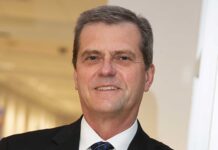
Hannu
Kottonen, 50, became president of Metsä Tissue
in October 2006. He came to Metsä Tissue from M-real
where he had been heading the Consumer Packaging Business
Area and was a member of the corporate executive board
since 2004. Previous to that Kottonen spent 20 yars
with the Huhtamaki Group, one of the world’s largest
packaging companies, in various management positions
including group CFO. Tissue World’s Hugh O’Brian
met him recently to get an update on developments at
the company.
“We are putting more emphasis
on the customer and consumer,
rather than on the mills and production”
TW: Was it difficult to make the transition from your
previous positions to the tissue business?
Although I am new to the tissue business, I
have a strong background in consumer packaging both from
M-real as well as Huhtamaki. The experience I have from
Huhtamaki, as a world leader in consumer packaging, is
especially good for understanding fast moving consumer
goods (FMCG) markets and bringing new insight. Thus I’m
very comfortable making the transition to tissue and
want to use my experience from the consumer sector to
help give Metsä sTissue an even stronger focus on
the consumers.
TW: Were things different from what you expected?
I
was surprised that the European tissue market is so fragmented.
Of course there are the big players but there are also
lots and lots of small players in regional or national
markets. There are still an incredible number of local
companies in this business so I feel it is incorrect
and even impossible to try to describe the European market
as one single market. In many ways the European tissue
business is a very local business. However, I am sure
this will not last forever and I believe that more consolidation
is going to happen.
Another surprise for me was how strong
our brands are and especially how strong the Lambi brand
is. It is the leading tissue brand in the Nordic countries.
We have also now established Lambi in the Baltic countries,
Poland and Russia. And the story continues as we want
to build the very successful Lambi brand even further.
TW: As you are both in the branded and private-label sectors,
are you seeking to grow further in brands?
Yes we are clearly emphasizing our brands and
I’m pleased to say that our brand sales have grown
by 40% in the last four years. That trend is continuing
this year as well with brands sales amounting to about €330
million.
TW: You had
earlier indicated that you might want to reduce the number
of brands that Metsä Tissue
is offering. What is the status now?
We are this year undertaking a very thorough
review of our brands. We’re doing a ‘bottom
up’ review and going through our portfolio brand
by brand. Most of that work is done now and the next
step will be to make an overall evaluation of the portfolio
and see what the best strategy is going forward.
TW: How
do you see the market conditions today?
Well, clearly, most parts of the European market
are pretty tough today. We are facing rapidly escalating
costs in terms of energy, pulp and transport to name
a few areas. On the other hand we have been quite successful
in pushing up prices so we are at least able to get
some of the cost increases back. This is not enough,
however, and we are still needing further increases.
TW: What new initiatives are
you implementing at MT?
Kottonen: We are putting more emphasis on the customer
and consumer, rather than on the mills and production.
The aim is to increase profitability by focusing much
more clearly on the consumer. We are also redefining
our business to put more focus on functions, process
ownership and of course accountability. As we have
expanded in recent years through acquisitions, we cover
more markets and regions. So there are clearly synergies
and efficiencies that we can use to our customers’ and
our own advantage and I want to make sure the organization
is set up to do this.
“We are clearly
emphasizing our
brands . . . brand sales have grown
by 40% in the last four years and
the trend is continuing”
We are also presently implementing a new operational
model which is intended to strengthen our supply chain
to squeeze out more efficiency. To me if you attack the
supply chain and really improve it, there are only upside
benefits. The reliability and effectiveness of the supply
chain is vitally important to our customers and thus
to ourselves. A key focus is to deliver on time and in
full (OTIF) to our customers. We consider this one of
the most important key performance indicators of our
whole operation. I should add that we are starting from
a good base, as the platform already exists within the
current Technology and Operations function, but we are
enhancing and upgrading it. For this reason we have recently
added a new function of supply chain to our operational
model and we have created a new position of senior vice
president – supply chain which we
have recently filled.
TW: What is your plan to grow in the future?
We
have lots of possibilities for growth but I would say
that our main emphasis is to grow the profit margin rather
than simply growing the size of the company.
TW: What
about new products?
We
are of course continuously developing new products and
we have a very capable development group based on our
Technology Center where we do a lot of product development
work based on a converting pilot line. In cooperation
with the marketing people and the mills they are undertaking
product development based on consumer insights. The key
aim here is to grow the value of the tissue category.
We want to be able to get more value for the tissue products
we develop and sell.
TW: What about the structured tissue such as TAD, STT
and ATMOS? Are you moving in that direction?
We don’t see the payback at this time.
We never got into the TAD market and although those decisions
were made long before I arrived here, I have to say that
I believe they were very smart decisions. I’m happy
not to be in that sector right now, which is confronted
by high energy costs and relatively low market demand.
As far as the newer technologies that are being introduced
by the machinery suppliers we have certainly taken a
look at them.
TW: What are you doing in the Russian market today?
Are you selling much there?
We have started to develop our market and brand
penetration.TW