Features
OCTOBER / NOVember 2007

Lilla Edet: A big work in progress
With good demand for its Edet and Tork brand products, SCA’s big mill in Sweden is looking at various ways to increase production in the most cost-efficient manner

By Hugh O'Brien


SCA’s Lilla Edet mill, located about 50 km north of Gothenburg, Sweden, is a very good example of the ‘mega-mill’ concept that SCA Tissue has been implementing since the mid-1990s. The idea has been to concentrate tissue production within the company at fewer but larger production sites which can give higher production and lower costs.

As part of this strategy, a rather new tissue PM from a smaller, now closed mill in Croisset, France, was moved to Lilla Edet in 1999.

Today the mill manager, or site manager as she is officially called, a Lilla Edet is Sussan Sandberg. A fast moving woman who walks at a rapid pace around the mill, Sandberg is always looking for the next continuous improvement opportunity which will raise operating efficiency and increase production even further.

High Demand From Sales
Based on high quality and low cost production, Sandberg says that Lilla Edet is very often the first choice for the SCA sales force, or category organization, when they are sourcing products from the SCA mills. “Our quality/cost ratio is very good so we quite simply have too much demand, although I’m not complaining about it because this is a good problem to have. Our team focus on continuous improvement helps us get more tons out of our existing asset base.”

Sandberg believes very strongly in continuous improvement and points out that production at the mill is up 20% since 2001. Recently the management and technical departments have been quite involved in the integration of the Jönköping, Sweden, mill since it was purchased in early 2005 when SCA took over the Munksjö Hygiene business. This included two mills, one in Sweden and one in Norway.

The Jönköping mill consisted of both papermaking and converting but now all of the converting operations have been moved to other locations and the paper machine is running very well. One very modern Perini Sincro converting line was moved to Lilla Edet, says Sandberg, which has helped her to squeeze more production out of the facility to satisfy the demand.

Lilla Edet today has three PMs, with a total output of around 100,000 tons per year. Of this, about 60% is AFH with the remaining 40% being consumer tissue. The site includes 14 converting lines. The Jönköping mill now makes about 20,000 tons per year of both AFH and consumer tissue jumbo reels, with most of it being shipped to Lilla Edet for converting. There are about 430 employees at Lilla Edet and 20 at Jönköping.

Getting Eveybody Involved

Sandberg joined SCA in 1996 initially working in the corporate R&D lab in Gothenburg. She has a Master of Science degree in papermaking from North Carolina State University in the USA and after that she worked at STFI and Akzo Nobel in Stockholm, where she was awarded a patent for a wet strength resin concept. Following R&D work at SCA for several years, she came to Lilla Edet in 2004 as paper production manager and soon after was named site manager. With the integration of the Munksjö facility in Jönköping, she also has responsibility for that operation today as well.

A key part of her job, says Sandberg is to make sure everyone and every department is communicating well so they can all be moving in the same direction. A key element in this is the daily morning meeting, which she feels is critical to involving all areas of the mill, from raw materials and pulp supply to logistics and transportation and everything in between, to get the best results.

“I really enjoy the entire production process and the challenge that comes with making the whole thing work,” says Sandberg. “It takes a high level of teamwork to get the best results and it is critical that everyone in the mill feels connected and involved. This is perhaps the most important job of a site manager: to get all people working together and to be aware that what they do has an influence on the success of the entire operation.”

Getting back to her favorite area of continuous improvement, Sandberg explains that she is pleased that the Jönköping integration is now completed and that focus on mill operations can now take priority.


“We had a lot of resources tied up with the integration. It was a rather complex project which took up much of our time, especially for the technical and engineering people, during 2006. It has been very successful and the cost situation on the existing PM 4 at Jönköping is now very good and we are running well with a very slim workforce there. So with that under control we are very happy to get back to our efficiency and production improvement work here at Lilla Edet.”

PM 7 Rebuild
A major project to increase drying capacity and slightly raise operating speed is took place in October 2007 with a 20 day shutdown. Costing on the order of 60 million Swedish crowns ($9 million) the rebuild includes a new 16' (4875 mm) Metso Yankee dryer, a new Advantage AirCap Yankee hood including air system and heat recovery system, minor rebuilds to the wet end, press and Yankee section, and a new tail threading system. A new crane system is also being installed.

PM 7 is a Beloit C-former built in 1967 and modernized several times. Reel trim width is 3410 mm, and speed 1,500 m/min. The original Yankee dryer was 15' (4572 mm).

In addition to PM 7, the other machines at the mill include PM 5, a Beloit unit which was started in 1960 and makes about 75 tons per day, and PM 8 which is a Valmet crescent former that was started in France in 1995 and now produces about 140 tons per day.

Pulp Supply
Lilla Edet is fortunate to have a couple of things working in its favor in the drive to keep costs down, says Sandberg. “When you look at the cost drivers in this mill, or any tissue
mill, it simply comes down to people, fiber and energy. We are always looking very closely at these costs and working hard to optimize them. A key factor in our success here has been the fact that we use a very high percentage of recycled fiber.”

About 85% of the mill’s fiber requirements are covered by the recycled fiber line (RCF) which processes 150,000 tons per year of sorted office waste (SOW) and old newspapers (ONP). This gives Lilla Edet a big advantage although Sandberg acknowledges that the situation has changed lately as demand for secondary fiber, especially the high quality sorted office waste (SOW) that Lilla Edet uses most, has soared due to pressure from the Chinese buyers. Thus prices have been pushed up, and supply is tight.

Another factor helping the mill keep costs down is the sludge combustion plant that was added in 2003. The Kvaerner fluidized bed unit burns the deinking sludge that results from processing 150,000 tons per year of sorted office waste and old newspapers that are the raw material for the mill.

The resulting sludge amounts to about 50,000 tons per year and is mixed with bio fuel such as wood chips and burned in the system, resulting in an energy recovery of 70 GWh of steam which is used on the paper machines for drying. Finally, the inorganic ash that remains after sludge burning is used for various applications such as road construction.

Logistics In Focus
As far as the future, it is clear that Sandberg has no lack of ideas to keep her and the mill staff busy. “With the Munksjö integration successfully completed,” she says, “I am very much looking forward to using our positive momentum and energy in many other projects here. We have lots of ideas we are working on, such as looking more closely at getting our converting line efficiency up a bit to help meet the demand.”

“Another efficiency-improving step will be a rebuild of the mill’s logistics structure, with a focus on the consumer side. This is a challenging area for us as we have a huge variety of articles to move around and keep track of and that means higher handling costs that I would like.”

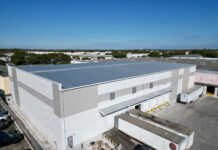
While the capital expenditure is not yet approved, Sandberg says that the mill is seriously considering a finished goods warehouse, mainly serving the consumer tissue sector, as opposed to the AFH products which are already rather well organized in the ‘high-bay’ warehouse that dominates the mill site.

Looking further down the road, she sees clear benefits that would come by widening PM 7 slightly to 3560 mm, from the present 3410 mm. The current rebuild on the dry end of PM 7 will size the dry end at 3560 mm so the next project would need to do the same at the wet end. This, she says, makes very good sense as it would make PM the same width as PMs 5 and 8, which would be a big advantage for interchangeability of parts. Of course the wider sheet would also mean higher production from the machine and very importantly, it would better fit the trim widths of the converting lines, thus giving less trim waste.

All told, Lilla Edet is looking to make lots of small improvements which add up to a big positive change. It is all a work in progress taking it one step at a time, or perhaps several steps at a time considering the speed with which Sussan Sandberg races around the mill, to make sure the operation continues to keep its mill efficiency high and its operating costs low. TW