It’s just 50 years since the young Fabio Perini, then 17, made the first of a series of inventions that have helped him build an industrial empire and, on the way, transform global thinking in at least two of his chosen business sectors.
That first invention involved taking the gearbox from one of the ubiquitous Vespas so popular in the Italy of the 1950s and using it to rig up a device for auto-guiding felts and wires. Since then, he has time and again introduced revolutionary concepts to traditional businesses.
Today, aged 67, and despite his long list of inventions and industrial achievements, Perini is still full or ideas and energy, even if, he admits, time is not on his side.
Just listing the enterprises in which he takes a leading role today – from tissue production to converting machinery, luxury sailing yachts to motor cruisers, medical devices to property development – gives an idea of the breadth of interest in a diverse and unrelated group of businesses. But in three of these he has become a world leader.
It is for this that last November the Italian president awarded him the prestigious Premio Leonardo (Leonardo prize), named after Renaissance genius Leonardo da Vinci, for his services to Italian enterprise. He had already been named Cavaliere del Lavoro, an honour similar to a knighthood in England – for services to the state – but the Leonardo is far more prestigious. Over the 14 years since it was inaugurated, the prize has been awarded to fewer than 60 leaders, including Ferrari, Giorgio Armani, Gilberto Benetton, Miuccia Prada, Sergio Pininfarina, Renzo de Piano and Paolo Bulgari to name but a few of the household names among the recipients.
Perini is gratified by his nomination. “It is an important award,” he says. But he plays down his personal role in earning it. “The prize is for all those who have helped achieve the successes we have had, not just me. Many people have contributed over a long period. The number one protagonist is the customer, whose faith in innovative products makes them possible.”
The fact remains, however, that while each member of the team has no doubt played his part, nothing would have happened without Perini himself, the driving force, indeed the inspiration, behind each development. Colleagues close to him are the first to admit that often they doubted his ability to make his latest innovation work.
What makes him special, said one, is his ability to go ahead with an idea at any cost, against all mainstream advice and the opinion of leading experts – and to make his ideas work so well that they become industry standards. A well-known example in tissue is the surface winder, which was considered a wild idea when it was introduced but is now almost universally adopted.
Less well known in our industry, though it has made plenty of waves in the yachting world, is the Maltese Falcon. This luxury 88-m sailing yacht, said to be the largest private sailboat in the world, is inspired by the clippers of the 19th century but incorporates a host of innovative materials and concepts that make it quite unique.
Clippers, which plied the seas from England to the Far East or across the Atlantic, were known for their high speed downwind, a product of the large sail area, but were limited in their ability to sail into the wind. Because of this drawback, and their relatively low carrying capacity, they faded from the scene.
Research in Germany in the 1960s into ways to make the clipper viable again led to promising theoretical data but it was never developed to working scale. When Tom Perkins, a US computer billionaire, asked Perini to build him a special yacht, though, this German concept was presented as one of the options, made possible by the development of fatigue-free carbon.
Perkins agreed to take the risk of going ahead with the boat if Perini was personally willing to back it. Working with naval architect Gerard Dijkstra, they cooperated closely to invent and test the new method of handling a huge sail area (2400m2) entirely automatically.
This is not the place to go into the technology of the Maltese Falcon. Suffice it to note that its three masts are supported without stays and that one man can solo-handle the 1200 tons of yacht with its 15 sails at speeds of up to 26 knots. And that other potential buyers have expressed an interest.
Perini himself was a world leader in the tissue business when he started building boats. It was a business he entered almost by accident – and to general astonishment at the madness of the concept. Luxury boats were supposed to be motor cruisers. Who could possibly want a 40-m sailing yacht? Well, first of all Perini did. Himself a keen sailor and in the market for a new boat, he was unable to find a constructor able to turn his ideas – for a 40-m boat with flying bridge, automatic winches etc – into practice. So he designed his own, which was built in Italy.
One thing led to another, proving all the critics wrong. In 1987, he acquired his first shipyard, in Viareggio. Today, he has that first one, seat of the head office of Perini Navi (Perini Ships) as well as two others in Turkey and Italy. Today, with an estimated 60-70% of the world market for large luxury yachts, he has 12 boats on order for a total value of €300 million.
In the 1990s he sold his then flagship company Fabio Perini SpA to Germany’s Körber Group and later left the tissue machinery business. But in 2002 he renewed contact with former colleagues Luigi Viani, Giulio Betti and Alberto Bianchini, who had set up Futura to design and build converting machinery.
Perini was one of the first customers for Futura, which supplied a complete 4.6 m line capable of handling all the output from a new Toscotec machine at Perini’s mill in Comceh, Romania. Based on the encouraging results of this innovative line, Perini agreed to become a partner in the new venture, which has now supplied 30 complete new lines in close to 50 major projects and has some 70% of business among the big companies.
The plans at Futura are to continue with the emphasis on quality and innovation. Perini commented that, as in many other ventures he has been involved in, you may not make money at the beginning, but if you insist on developing high quality products, the market will reward you eventually. He sees Futura as in exactly this position and is optimistic that when the upturn comes, tissue will start making money again. At which point, so will the machinery suppliers who have invested the most in research and development. More innovations are to be expected from Futura in 2008. Some are, it seems, already in a very advanced state of prototyping and will be launched during the year, but no further details are currently available.
Alongside Perini Navi and Futura (and associated companies Focus, MillTech, Joinpaper), Perini is also involved in two other highly successful enterprises. In Brazil he owns and manages Perini Business Park near Joinville in Santa Caterina State. And he has a small but fast-growing company, Cisa, that makes sterilisation systems for hospitals.
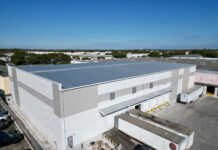
Perini Business Park is a high-tech industrial real estate development which manufactures its own high-quality pre-fabricated components, builds the sheds and rents them, as well as providing infrastructure such as transport and canteens. The park has 200,000 m2 of land, used by Perini’s own Faper Group companies but also rented to Brazilian and multi-national tenants. Today over 4000 people are employed in the complex, which is still only 30% full.
Even here Perini had the ability to surprise. Despite having had no training as an architect, he himself has developed a new patented roofing system with special air circulation features that is used throughout the complex.
Cisa is another company which well illustrates Perini’s business philosophy, which he sums up as striving to be best – not necessarily largest – in the chosen sector. Cisa claims to have the best technology in the world, based on 10 years of heavy investment in R&D, though Perini himself admits to a more hands-off approach here. At any rate, the company is growing at breakneck pace: from €22 million sales in 2006 to €40 million in 2007 and an expected €60 million this year.
One of the most extraordinary aspects of this disparate group of companies is that they really have nothing in common. There are no synergies to speak of. All the businesses are independent. None has much contact with the others.
The one unifying bond is the Perini philosophy: to be market leader, using innovative technology to create new opportunities and efficiencies. And to enthuse a team with the passion required to maintain leadership.
In stream, Perini Navi’s house magazine, he is quoted as saying:
“When you lead a market, you reach the top of a hill and you can see down on the other side, when your competitors are still only looking up to the summit. This is the time to accelerate your expolorations, to take advantage of your position and cross the valley as quickly as possible so you can climb the next hill and look down again. Because if you stop up there, sooner or later everyone else will catch up with you.
“The world is full of companies that believe they have reached the top and just sit down, and literally within months, without even knowing what happened to them, they collapse. Primarily because the market is like a bicycle race. Following is always easier than leading. And then because, when you lose momentum, it’s not so easy to get it back. It’s a fact that squatters are not the best runners.”
At the same time, the Perini approach is a very personal one. The companies are characterised by one close colleague as “like a big family – everyone is taken care of.” Industrial relations are good within the group. “Perini is no socialist but he gets on well with the unions,” said one senior colleague.
Perini’s own enthusiasm is most palpable when he is speaking about his beloved boats. In tissue recent years have seen developments that Perini deplores, notably the growing role of the retailer, who is squeezing producers to the point where they can no longer afford to introduce new technology. In the luxury world of private yachts the constraints are of a different order.
He professes, though, to draw great satisfaction not only from Perini Navi but also from his other ventures. “In some ways, tissue is most satisfying, in others shipbuilding,” he says.
Different products, different customers with a multiplicity of approaches, but always the same result: innovation What next? Well, there is a motor cruiser in the pipeline, the first that Perini will have built – “ to keep alive the name of Pichiotti, one of the most illustrious in Italy” (a shipyard he bought in 1989). Beyond that, who knows?
One thing is sure. Given time, Fabio Perini will continue to develop new ideas because he lives and breathes to do that. When asked if, at 67, he isn’t thinking of retirement, his response is instantaneous: “Never. I will never retire.” TW