Lincoln Paper & Tissue (LP&T) specialises in deep-dyed tissue products and printing papers. The company operates a fully integrated pulp and paper facility with three tissue machines (70,000 tons/yr total) and two high bulk uncoated freesheet (woodfree) paper machines (80,000 tons/yr total) in Lincoln, Maine, USA.
The fact that LP&T, a tissue maker, is integrated with on-site pulp production makes it highly unusual, but more of that later. The news from LP&T is its investment program and the faith which this displays in the continued potential of the North American tissue market.
LP&T sells parent rolls into the market – it doesn’t convert. The company supplies one- or two-ply parent rolls in a variety of widths and diameters. The new Metso DCT 100 HS tissue machine which LP&T installed last year is used for production of commodity white grades, napkin and white towel for the away-from-home market. It also produces a small volume of bathroom tissue. The 2.7 m-wide tissue machine has a maximum operating speed of 2,000 m/min. The two earlier tissue machines produce deep died and pastel coloured tissue and bonded white napkin. All LP&T tissue is positioned as a premium product, even in commodity grades.
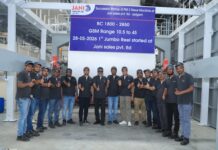
Unwilling to see one new piece of technology let down by downstream bottlenecks, the company has followed the installation of its Metso crescent former tissue machine with a Focus rewinder. The 2700 mm machine with Focus’s proprietary Automatic Caliper Control (ACC) system, features two unwinders, automatic shaft extraction and trim suction with separator. At 2000 m/min, it is said to be one of the fastest rewinders on the market, and features acceleration and deceleration ramps of 30 m/min/second.
The rewinder is a standard width model, designed for finished reels of up to 2 m diameter, and equipped with an automatic spool handling system, which manages spool extraction from the finished roll, insertion of new cores and transfer on the winder loader.
The cycle is started by the operator once the roll has been released on the unloading table. The operator only needs to load the cores in the dedicated magazine. The system allows for production optimization, since a new roll can be wound during the extraction and transfer cycle.
LP&T president Keith Van Scotter explains: “We chose Focus because we think that they had the right background in tissue converting – probably the most proven technology for what we wanted to do, in the context of trying to take parent reels off the tissue machine and convert into one or two-ply split rolls. What we have achieved is a very tightly controlled, consistent wound roll.
“ACC (Active Caliper Control) is the concept of how they use the rider roll. It’s pretty close to a tensionless wind. We wanted to retain bulk and have a good quality.
“The Focus rewinder is a very solid, very well engineered, impressive piece of equipment. Given the magnitude of this project, it’s been challenging across the board, but it’s a very nice piece of equipment. It makes beautiful rolls from the good quality paper coming through it, and it’s pretty much a 24/7 365 day a year operation.”
Van Scotter: We make some special
products
and
we are very good at it.
We’ve been on a very aggressive
growth path
and I think our customers
appreciate what we’ve done
Focus sales manager Mario Rivis said: “Following the start-up in
China for Hengli, this is the first winder we have installed in the US, but
not the first machine: in October 2006 a reel was successfully started-up
at Scott Paper, Canada, followed by a second one at KTG USA.
“On all these machines, the roll is controlled electromechanically using ‘Active Caliper Control’ (ACC). This is Focus’s own system which allows for a higher winding uniformity, with subsequent reduction of the wound-in tension and, therefore, less bulk loss.
“On the winders at Hengli and Lincoln Paper and Tissue, hydraulics are only limited to the unloading platform and the spool handler, since the unwind stands are also electromechanical. In the case of out-of-roundparent rolls, this system avoids oscillation of the unwind arm, thus ensuring a better control of the roll.”
The Focus winder is designed with the aim of reducing the bulk loss during winding. This is achieved by the combined use of ACC and load cells which measure the nip during the winding phase from beginning to end.
THE TRADITIONAL ALTERNATIVE

In traditional winders, either pneumatically or hydraulically controlled, the spool is pushed away from the carrying drums by the build-up of the roll which is being wound. In this way, because of the internal frictions of the system, rider roll and chucks do not move continuously, but tend to “jump”. In other words, they move only when the force exerted by the increased diameter of the roll exceeds the internal frictions of the system. At this point the chucks and rider roll move away from the drum and remain there until pushed back in a new position by the build-up of the roll.
This stop-and-go movement of chucks and rider roll determines variations in the nip, thus creating areas of different hardness in the roll which increases the wound-in tension and therefore increases loss of bulk, too.

In the Focus winder, chucks and rider roll are not pushed away by the build-up of the roll but follow the increase in diameter from the beginning to the end of the winding cycle. This allows a more uniform winding the consequence of which is the reduction of radial stresses, which has the effect of reducing bulk loss.
The movement of chucks and rider roll does not have any effect on the wind pressure, which can be maintained at the same level from start to finish of the winding cycle, or can be relieved for a further reduction of wound-in tension.
PULP ON-SITE
So how about that rather unusual pulp facility at LP&T – ususual in the sense that it exists alongside the tissue machines which it supplies? As a reader of this magazine, you hardly need to be told the connection between pulp and tissue. But virgin pulp is something which tends to arrive in tissue mills on the back of trucks rather than being manufactured on site. Even tissue makers with integrated production only tend to be integrated in as much as the group of which they are a part also makes pulp. It is rare indeed for anything other than pulp from recycled fiber to be produced on the same site as a tissue machine.
Lincoln manufactures 140,000 tpy of bleached kraft pulp on site from sawdust from surrounding saw-mills and hardwood chips from the local forest. Van Scotter explains the attraction of having your own pulp production facility on-site: “There is a cost advantage in producing your own pulp, as well as availability and consistency. Tissue is a very technicallychallenging product. To make a good quality consistent tissue is no easy task, but having our own pulp facility certainly helps us achieve this.” LP&T doesn’t need to source any pulp from the market.
LP&T started life in 2004 when the mill in Lincoln, Maine was bought out of bankruptcy. The mill had produced pulp both for its own paper production and to sell to the market. The buyers, including Van Scotter, considered the tissue industry to offer the best opportunities in the paper industry, and saw potential to develop the mill in this direction.
Tissue is not new to the mill – the first tissue machine was started up at Lincoln in 1966, but the new tissue capacity which LP&T brought on line used up the surplus pulp production, such that LP&T no longer supplies pulp to the market, but neither does it need to source any from outside. Van Scotter remarks: “Tissue is the one grade which is going to grow - not being faced with any kind of substitution threats. The US is mature but a growth rate of 2 to 3 percent still means a lot of extra capacity. Tissue tends to grow along the lines of GDP.”
SPECIAL PRODUCTS
“We make some special products,” says Van Scotter, referring to the deep dyed napkins, “and we are very good at it”. All production is sold in North America.
“We’ve been on a very aggressive growth path and I think our customers appreciate what we’ve done.”
So what’s next for LP&T? “We are interested in improving our energy and environmental profile,” explains Van Scotter. “We are working on improving our ability to self-generate electricity, which is underway now with a steam turbine generator.” The strong theme of self-reliance continues.
TW