Features
APRIL 2007 / may 2007

A good deal for Dalle
The new OCME palletization system at Kartogroup’s Dalle Hygiène facility is set to pay for itself in two and a half years

By Jonathan Roberts

Dalle Hygiène, one of Kartogroup’s 10 production and sales companies in Europe, recently took delivery of an automated palletization system at its plant in Bousbecque, near Lille in northern France. The results have been extremely positive for the company, increasing efficiency and flexibility, and reducing bottlenecks at the end of the line.

THE CONTEXT OF THE INVESTMENT
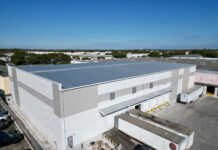
Before the details of the installation, let’s put it in context. The company’s 25,000 m² converting facility and associated warehouse was set up in 2005, some two years after the second tissue machine started up at the tissue mill just down the road. The two tissue machines produce some 60,000 tpy between them.

Dalle Hygiène now concentrates on the domestic market having pulled out of away-from-home last year. The company produces mainly private label products in the form of bathroom and facial tissue, and kitchen towel. The majority of these products are destined for French, Belgian and Dutch supermarkets. Other markets include Spain, Italy and Germany, although Kartogroup has plants in these countries so it is only for certain specific, limited needs that Dalle Hygiène’s products need to travel so far. Of course not every mill can produce every product variant, but Kartogroup, with its spread of facilities, clearly aims to minimize unnecessary movement of product.

A small amount of production is sold unconverted as jumbo rolls, destined mainly for the UK. A small and dwindling number of jumbo rolls are purchased from outside the group: “There are products which we can’t produce from our own tissue production, but we are looking to make an investment to answer all our needs internally,” says Kartogroup consultant and European project manager Massimo Lungone.

THE MOTIVATION
Dalle Hygiène’s main motivation was to increase efficiency by reducing the manual input in the palletizing process. In this respect, the investment has been a great success. Prior to the project’s inception, there were 48 people working at the end of the line – a situation prone to complication.

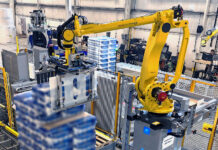
The company invested in an OCME system comprising seven robotic palletizers, three laser guided vehicles (LGVs) with forklift attachments, and three LGVs with conveyors, to deliver loaded pallets to the stretch wrappers.

The end result after the equipment was installed is that palletization has been totally automated – there are no operators permanently located at the end of the line but there are two technicians per shift for the whole system. The equipment was installed in 2006 and return on first main phase of the investment is expected to take just two and half years.

Construction and installation of the line took four months. Dalle Hygiène chose OCME as the supplier for the project because the equipment it proposed was the right price and could be delivered within the desired time-frame.

MORE THAN PRICE
But there was more to it than that: As Mr. Lungone says, “They made a better analysis of our products and palletization needs. Others offered the same results but were more expensive because they offered technology we simply didn’t need. The system we now have is modular and we can extend it to meet any possible future palletization needs. If tomorrow, commercial needs dictate that we need to produce some new products, we can buy components as necessary.”

At present, each station – there are seven in all - is served by a single robotic palletizer designed to create 25-62 pallets per hour depending on products involved. This set up is perfectly adequate for the relatively straightforward pallet loads which Dalle Hygiène requires for its customers. Should pallet requirements become more complicated, with a greater mixture of products on each pallet, then it might well become necessary to add a small extra robot to one or more stations, which would prepare the product groupings in suitable layers ready for the main robot to place them on the pallet. This is perfectly possible with the OCME system, but would have been an example of over-specification if installed at this stage.

“We are very pleased with the OCME line,” says Mr. Lungone. “We broke production records after the installation, and discovered, as we had guessed, that manual palletization had been a bottleneck.”

ROLE OF LGVS
The use of LGVs instead of forklifts has brought two particular advantages. Firstly safety: the potentially hazardous combination of people and trucks all working in the same zone is now avoided. Secondly, a potential bottleneck has been avoided, as forklifts operated by drivers have to stop from time-to-time and are generally less predictable and reliable than LGVs.

Automation has had further benefits from a personnel point of view. Dalle Hygiène can now build up eight hours’ worth of production without personnel intervention, which equates to a substantial buffer of pallets – around 700. This considerably reduces the need for expensive night-shift work, as production can continue unaided through the night. It also helps the mill cope with the irregularities of delivery truck movements. Sometimes a few trucks will arrive at the same time, and the buffer stock combined with the availability of staff who are freed up by the automated palletization system, means the trucks can be in and out much more quickly than before and production never stops because of a missing forklift.

The warehouse is not yet completely automated, but it would only take an extra three LGVs, determination of of warehouse layout, space, automation is an ongoing project.

Massimo Lungone is now a private consultant, whose company Studio Lungone can be contacted at studio@lungone.191.it. Also see www.studiolungone.it

Kartogroup profile

Kartogroup has annual sales of approximately Euro 450 million, generated by 10 production and sales companies:

Italy: Kartogroup, Linpaper, Kartocell, Sud Europa Tissue
France: Dalle Hygiène SA and Dalle Hygiène Production
Germany : Kartogroup Deutschland
Holland : Kartogroup Benelux
Hungary : Kartongroup Magyarország
Spain: Kartogroup España

The company produces and converts tissue. Expansions in recent years, apart from the French operation, include the 50,000 tpy German mill which was started up in 2004, and the 110,000 tpy converting plant at Sanaletti in Italy. Kartogroup produces brands, namely Perla and Scala, private label and away-from-home (AfH) products (under Kartogroup Professional brand).