By Bill Nelson
The tissue sector is no different from other industries
in its scepticism towards change. This does not mean that change
does not occur, but innovation within the industry is mostly
measured in small increments rather than giant steps. However,
the reality is that the companies which have the foresight to
introduce new technologies and ways of working tend to outperform
their competitors. Change is predominantly good but can be difficult
to embrace.
As greater demands are placed on the tissue industry to deliver
product at a lower cost, more pressure is placed on plant distribution
systems to handle increased stock keeping unit (SKU), manage inventories
more efficiently and reduce costs directly attributable to the
distribution centre. As a result, suppliers to the tissue industry
strive to make advances in equipment, eg rapid change-over, new
unwind stands, higher cycle rates.
At Elettric 80 (E80) we are continually introducing new products
to the global marketplace to address client requirements. The
most recent addition to our LGV family is the Giraffe. The Giraffe
has a reach capability of 9-m and a maximum pallet weight of 1200
kg and is able to work alongside manual fork lift trucks in a
rack storage environment to ultimately improve safety, increase
flexibility and reduce storage handling costs on-site. The Giraffe
can be programmed to manoeuvre in a 3-m wide corridor and due
to its small footprint can replace existing manual fork lift vehicles
in a facility without the need to change the racking environment.
The Giraffe complements our existing technology, such as multi
pallet handling LGVs for block stacking.
DISPLAY PALLETS
A standout development we have launched worldwide
has been the Dragon palletising robot islands for display pack
pallets, a system which addresses the tissue industry’s
requirement for high-speed palletizing and cost effective flexibility.
Many tissue manufacturers require a display-ready automation
solution due to the demands placed on them by major retailers
and supermarkets. The small footprint of the Dragon is designed
for updating existing lines if a client requires display- ready
products.
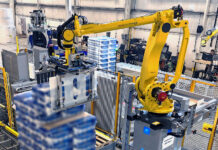
The Dragon system is really three robots in one. The system
has an intelligent in-feed system that separates and groups packs
entering one by one, from one or multiple packaging lines. Once
the packs are grouped by the in-feed separation system, each pallet
layer is formed by a specially designed gantry robot system. Finally,
the layers are stacked by a Fanuc robot.
The software that drives the Dragon allows the operator to visually
select each product configuration through a PC interface.
Product changeover, new product configuration set-up and troubleshooting
are also performed through the same operator interface.
The Dragon system is designed to handle the output of the fastest
rewinding and packaging lines and can be closely coupled to any
packaging stream, whether a wrapper or a bundler, and can handle
up to 200 packs a minute. The Dragon’s efficient packaging
capabilities permit its end users to save money on packaging costs,
while not sacrificing efficiency or speed of their production
lines.
Since its launch, over 60 Dragon display palletisers have been
deployed worldwide. However, every market is different and for
North America E80 has developed a hybrid Dragon which is capable
of handling not only small packs and bundles but also case-packed
product.
PARENT ROLL MANAGEMENT
In 2007, E80 launched the Elephant LGV system which
uses clamps to handle parent reels, thus minimising the risk
of damage through the end-of-line process. For markets such as
North America, this was a completely new concept. The system
includes the following features:
- Pick parent reels at discharge of paper machine;
- Deliver parent reels to warehouse and manage inventory
in FIFO by row;
- Pick reels for warehouse and deliver them in matched
sets to rewinders upon request from converting
operators; and
- Manage warehouse inventory through E80 custom WMS interface.
The success of this project is predicated on the timely pick
up and delivery of reels. The system also reduces damage caused
by the manual reel handling process. This has always been a real
industry issue, what the Elephant system does via the clamp technology
is to intelligently manage the handling of the parent roll so
that it can understand the characteristics of each roll during
the end-of-line process. The initial feedback from the customer
indicates that our system has greatly reduced the previous damage
done to reels by excessive clamp pressure and clamp truck drivers
rubbing clamps against reels in the warehouse.
As part of the system, E80 developed reel management software
and a vehicle guidance system which permits multiple LGVs to navigate
on multiple floors, while stacking reels two levels high in the
warehouse and delivering them to each rewinder. The system tracks
roll characteristics and provides a complete inventory count in
real time for use by paper making and converting planners.
E80’s customer has confirmed that the amount of paper
stripped from each reel for converting has been greatly reduced,
in some instances to only one wraparound reel. E80’s calculations
indicate that the LGV will pay for itself within one year due
to the savings in waste paper alone.
FINISHED GOODS MANAGEMENT
LGVs which handle finished goods are nothing new
but technical advances now permit them to do much more. E80 has
developed its own WMS which works alongside and integrates with
many existing WMS or enterprise resource planning (ERP) systems.
This means that the existing WMS requires minimal change and
any additional WMS functionality required for the automation
process can be easily integrated with the help of E80 software.
The standard WMS software modules are frequently tailored to
a specific requirement and can be programmed to cope with seasonal
variations or cycles within a warehouse or production area.
The WMS software design incorporates product location, quantity,
size, and order information to determine where to stock, where
to pick, and in what sequence to perform these operations Housekeeping
functions and auxiliary transport needs are easily managed by
the WMS. A customized man machine interface (MMI) is available
in the WMS to provide day-to-day operation of the system. System
set-up is simple. If needed, software can act as the main WMS
or be part of a wider bespoke solution. The software is dynamic
and scalable and can be configured and integrated into different
system environments.
The combination of new high-speed LGV navigation technology
and the WMS software can help reduce product handling costs. Wolf
is a new clamp LGV with programmed variable pressure clamps that
gently handle unit loads, thus reducing creases in cased product
that sometimes causes stack instability in the warehouse.
Some key features of the Wolf/WMS system are:
- Full product tracking from production to shipping dock;
- Variable programmed clamp pressure;
- FIFO-by-row;
- Multi level stacking;
- Prioritisation of work orders;
- Quarantine/block sections for quality inspection; and
- Housekeeping and consolidation functions.
This system is capable of handling incoming products from other
locations. The final step in this process is staging trailer loads
at the shipping dock.
E80 equipment is designed to meet CAT III safety requirements.
Its LGV systems are proven to be safer than lift trucks. All LGVs
are equipped with 360º of coverage by PLS laser scanning
safety sensors that detect the presence of people or other obstacles
and slow or immediately stop the vehicle until the obstacle has
passed.
This safety sensing system that protects personnel also eliminates
damage done by lift trucks to buildings, conveyors or other fixed
objects in the plant.
Bill Nelson is sales director Hygienic Products
with Elettric 80 North America.