Operation Report: Pehart Tec takes the lead
Pehart Tec’s two new tissue machines side by side in the mill. On the right, Over Meccanica’s rebuild of the
original Beloit machine. On the left, the new Toscotec unit.
|
|
|
In mid-2009, Romania’s SC Pehart Tec SA brought on stream a new tissue
production line at its plant in Petresti, Alba County, Transylvania. This
new unit, TM7, is an AHEAD 2.0S line from Toscotec with an overall capacity
of 110 tons/day. It followed on just a couple of months after a new converting
line from CMG Group for toilet tissue and kitchen towel that can handle some
10,000 tons/yr of paper.
Together with an Over Meccanica machine that started up in January 2007,
it gives the company around 50,000 tons/yr of high-grade tissue, much of
it converted in the mill, making it one of the country’s leading producers
in both volume and quality.
The company does not plan to stop here. Already it is working on plans
to add two more converting lines in the near future, either at the Petresti
mill or in another location. It is also considering the addition of a cogeneration
plant. The hood on the new Toscotec machine is designed to accommodate such
a conversion and the investment is earmarked for 2011. Looking further ahead,
more expansion seems just a matter of time.
|
The Petresti mill has a long tradition in paper production. It was founded
in 1873 based on the rich wood resources in the surrounding countryside. After
the change of regime in 1989, the employees bought the company from its state
owners but capital was lacking for essential investment and in 2005 MG Tec Grup,
owned and run by Ioan Tecar, its president, took over the whole operation.
MG Tec, based in nearby Dej, Cluj County, comprises 14 companies and is active
primarily in building materials. From the outset, it says, “policy management
was based on the principle of investing in modern technology machines with integrated
feed production, able to make quality products at international standards.”
The company has lived up to this philosophy. Since 2005 it has invested some
€40 million in the Petresti mill. In 2009, to ensure the flow of capital
would continue, the company brought in the European Bank for Reconstruction & Development
(EBRD) as a 25% shareholder, which makes it easier for the company to get
credit.
EBRD considers its stake a long-term investment – at least 5-6 years, maybe
more. It has a director on the board, it sets targets, and it is intimately
involved in the strategic development of the company.
So far, progress has been more than satisfactory, according to company management.
Annual turnover has grown to more than €40 million and is rising rapidly and
the company is continuing to sell all it can make, sharply growing its market
share in 2009, which augurs well for the coming years.
The Romanian market for tissue products is expected to double in the coming
10 years, reaching 200-250,000 tons by 2020, for a per capita consumption of
around 10 kg. This seems eminently reasonable, given current low levels of demand
– 4.5 kg per person per year, compared to 10 kg in Hungary, 6 kg in Bulgaria
– and expected GDP growth. It gives dynamic companies such as Pehart plenty
of scope for growth.
Right now one of the main goals for the company is to extend its sales network
into the country’s rapidly-growing supermarket sector, which has grown from
virtually zero 10 years ago to a position of importance today. Getting supermarket
space is a complicated business, with shelf tax and other costs, but the company
is making a big thrust in this direction.
It has been selling its main brand, Pufina, for four years but until recently
production has been limited by converting capacity. Today, with the new CMG
line in operation (making 30% Pufina, 70% other brands, including private label),
it can promote Pufina and its new brand Alint into the major distribution networks,
which should help boost market share sharply. Further down the track it foresees
the launch of several new brands. Pufina comes in a range of qualities and styles,
all in the premium end of the market. Pufina Soft is a white two-play product
with no perfume or print; Luxe is three-ply with perfume and print; Art has
two plies and print but no perfume. In the market soon will be Pufina Gold,
which will add yellow to the range. Alint will be a high-quality product based
on virgin pulp but will target a more economy-minded consumer.
THE INVESTMENTS
When MG Tec took over, Pehart was making 400-500 tons/month of paper on two
machines and a small volume of egg trays on a third line. But the company was
little known and selling was tough, particularly in the domestic market. Tecar
was convinced of the potential in the consumer tissue market, however, and decided
to rebuild one of the existing machines with the latest tissue technology to
compete in the premium end of the market.
He called for tenders but received only two responses, one of them from Over
Meccanica, which was awarded the contract on a turnkey basis. This was for a
complete new stock prep plant, crescent former wet end and press for an existing
Beloit machine, plus a new rewinder with three unwind stands. The original 4.6
m Yankee as well as the frame from the existing unit were re-used but with trim
width increased from 2.3 to 2.5 m, with a new Novimpianti hood and with drives
and QCS from ABB. The machine, PM6, shut down in December 2006 and restarted
at the end of January 2007 and from then until the end of 2007 orders exceeded
the mill’s capacity.
This success led to a rapid decision to add the second new machine. This time,
eight companies submitted tenders, and for a combination of technical and financial
reasons, the company chose Toscotec. The turnkey contract covered the complete
paper machine from stock prep to rewinder. At the same time a new 2.75 m CMG
converting line was ordered. The converting line started up early in 2009 and
the tissue machine a few months later.
Toscotec’s turnkey project includes AHEAD 2.0S tissue machine with doublelayer
headbox (TT Headbox ML-T), 15’ Steel Yankee Dryer (TT SYD 15FT), machine auxiliaries,
stock preparation plant for virgin pulp, a three-ply tissue rewinder (TT WINDH)
complete with roll handling system, electrification and control system. The
machine has a net trim width of 2750 mm and runs at up to 2000 m/min making
110 tons/day of tissue.
Pehart truck showcasing the company’s premium product line
|
|
|
Thanks to the strong cooperation between the Pehart and
Toscotec teams the target of the project was matched in terms of quality
and timing and the start-up of the new plant was reached in less than one
year from the order date.
The project handled by Toscotec on a turn key basis has its particular
features on the fact that the machine has been designed with the best available
technology looking in all the details on the energy savings aspects. For
this reason, as noted above, the hood has been supplied with special features
that will allow in the near future to be fed with cogeneration gases produced
by a turbine making paper production more economical. |
At the same time as the tissue machine, Pehart installed
its first TMC packaging line in mid-2009. The Italian company was responsible
for a UNO Wrapper (the new generation of fully automatic, high speed wrappers),
an FBS400H Bundler, and a complete package of conveyors for the line connection
and integration. All lines supplied offer maximum flexibility and are capable
of running -standard packages with horizontal core BRT, vertical core packages
and big KT (up to 165 mm diameter).
In addition to these two modern lines, the old PM5 continues to make a
small tonnage of waste-based tissue and the egg tray line is still operating.
But these parts of the business generate less than 10% of total turnover.
The future is clearly with the new.
For technical manager Cristian Silas, working with these two new machines
is a “real pleasure”, he told Tissue World. Normal teething problems apart,
they produce highquality paper at high speed, a new experience for him and
his colleagues, all of them inexperienced or used to older, slower machines.
Clearly, they provide challenges for a workforce not accustomed to the technology,
but Silas sees the enthusiasm of the young machine crew and their steep learning
curve as a big plus for the future.
The last three years have seen Pehart Tec take giant steps forward. In
2006 it was a small producer of low-grade paper, mainly sold as jumbo rolls
in a fiercely competitive market. Today it has Romania’s most modern machine
park, it is branding a rising percentage of output in the premium end of
the market, and it is eager for further expansion. |
|
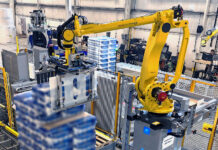
CMG converting line (top) and part of the TMC packaging line (above).
|
|