|
|
| AUGUST / SEPTEMBER 2009 | Home |
| |
 |
Country Report: Egypt
Click on charts below to view a larger version
 |
Bar chart displaying the distribution of paper machine widths comparing Egypt with other T&T machines in Africa. |
| |
|
|
 |
Bar chart displaying the distribution of paper machine technical ages comparing Egypt with other T&T machines in Africa. |
| |
|
|
 |
Bar chart displaying the distribution of paper machine annual production rates comparing Egypt with other T&T machines in Africa. |
| |
|
|
 |
Bar chart displaying the distribution of paper cash cost to the reel comparing Egypt with other T&T machines in Africa. |
| |
|
|
 |
Pareto chart of T&T production capacity for Africa. Note that two countries stand out with the highest production capacity: Egypt and South Africa. |
| |
|
|
 |
Pie chart displaying the % of tissue machine dispersion by country. Note that more than one half of the machines in Africa (64%) are located in Egypt and South Africa. |
| |
|
|
 |
Bubble chart comparing by-country production capacity to machine technical age with bubble size representing the number of machines making up the country production. |
| |
|
|
 |
Map of Africa locating paper machine producing cities. Note: Integrated (squares) and paper-only (circles) mills are differentiated on the map. |
| |
|
|
 |
Zoom map highlighting Egypt paper making cities. |
| |
|
|
Egypt’s tissue industry has boomed despite low consumption. Today, capacity is at least three times demand and still
growing, with export markets the target for most of the new supply
Egypt’s consumption of tissue is
expected to be just 60,000 tons this
year, representing per capita
consumption of a mere 0.7 kg. There are a
number of challenges to growth. GDP per
capita is low ($5400, 135th place worldwide,
according to US government statistics).
Illiteracy is high and hygiene awareness is
poor, especially in rural areas, according to
local suppliers. In addition, social habits
generally favour the use of water instead of
toilet paper.
According to Nuqul Group, “Egypt’s
economic environment provides affordable
labour, energy and water as well as political
stability. On the other hand labour efficiency,
volatility in energy prices, bureaucracy and
changes in regulation and laws provide
challenges.” Multiple distribution channels
exist (kiosks, haberdasheries, micro-size
pharmacies and small groceries). In an area
equivalent to 30% of Europe they sell tissue
products worth 1.2% of Europe’s market.
Despite the low consumption, Egypt has
a modern and apparently strong tissue industry,
with eight mills running 13 machines and
with annual capacity estimated at over 200,000
tons, which will rise by 30,000 tons in the
first quarter of 2010.
The industry is remarkably modern.
According to Lockwood-Post Directory, six
of the 13 machines have been installed in the
past five years, while at least two more have
undergone substantial rebuilds. Another new
machine is due next year. When it is running
normally, some 80% of Egypt’s production
will be on machines that have started since
2005.
Three companies dominate the industry:
Nuqul, with 75,000 tons of annual capacity
on two machines; Pyramids (part of the Zeritis
Group) with about 60,000 tons on four
machines; and Interstate, which has only
30,000 tons on a single new machine today
but is adding a second that will double capacity
to 60,000 tons early next year.
Nuqul Group (NG) is the leading company
in Egypt and throughout the Middle East.
With its headquarters in Amman, Jordan, it
has branch offices and manufacturing plants
in Saudi Arabia, UAE, Kuwait, Palestine,
Sudan, Iran, Morocco, Algeria, Lebanon, and
Yemen as well as Egypt. Its broad
manufacturing base and aggressive marketing
strategy have enabled it to
extend its operations to
more than 40 markets.
NG established its
Egyptian subsidiary Al
Bardi Paper Mill in 1989,
starting with a state-of theart
converting plant
producing a wide range of
products. This was
followed in 1991 by the
first tissue mill, which
started as a 17,000 ton/yr
facility. According to
Magdi George, Chief Area Officer, Africa
region, “this first machine was the seed in the
so-called Nuqul Tissue business unit which
today comprises four tissue mills, two in
Jordan and two in Egypt, with a total capacity
of 160,000 tons/yr”.
Al-Sindian, which is located right next to
Al Bardi, has the country’s largest tissue
machine, a 5.5 m Metso Advantage DCT 200
that runs at up to 2000 m/min and is rated at
54,000 tons/yr of paper. Metso delivered the
complete tissue machine, including an
Advantage AirCap and ventilation equipment,
an OptiFlo II TIS multi-layering headbox, as
well as Advantage Run sheet transfer and
stabilizing technology and an Advantage
GlueTurn-Up system.
Al Sindian Paper mill uses 100% virgin
fibre. It has two main stock preparation lines,
one each for long and short fibres. It has
completely automated pulp handling
equipments supplied by Sicma of Italy. The
stock preparation is supplied by Andritz to
feed the two-layer headbox. The machine has
a slitter and a shaft puller in order to supply
the converting lines with one ply jumbo rolls.
The roll handling and wrapping is also
supplied by Sicma.
Water for the mill comes directly from
the municipality as drinking water. The water
is mainly from the Nile river. Effluent water
from both mills is combined and treated at a
mechanical treatment plant and the water is
disposed properly at the city municipality
system.
|
|
Cairo has the biggest share of the total tissue business (69%), while the Canal region is the smallest (Source: Nuqul Group).
|
Egyptian market shares by tissue category, showing the importance of pocket packs.
|
|
“We have a cogeneration plant on site
that burns natural gas in order to generate
electricity for all the site. It feeds Al Sindian
paper mill, Al Bardi Paper mill and the
converting plant,” Hani Nuqul told Tissue
World. The hot air from the turbine is used
inside the hood at the machine in order dry
the paper.
Al Sindian and Al Bardi paper mills share
several resources together such as power,
water, steam, management, man power,
security, safety, transportation and
administration.
There is a new face on the Egyptian scene,
Interstate Paper Industries (IPI). Located in
the private free zone of Sadat Industrial City,
mid-way between Cairo and Alexandria, it
started up its first machine in June and has
another under construction and due for startup
in July 2010.
The Government of Egypt sponsored three
such industrial cities (6th of October, 10th of
Ramadan, and Sadat City), to attract the
population away from Cairo in order to
alleviate the city’s congestion and pollution.
Basic infrastructure (roads, electricity, water,
sewer collection and treatment, phones etc.)
and services (residential housing, schools,
commercial centres etc.) are provided by the
developers.
The scheme has been a success in
attracting investment to the tissue sector.
Though 70% of Egyptian consumption is in
Cairo, all but one of the tissue mills in the
country is on one of these free zones, ideal
for the growing export industry. Only Alex
Converta, with a 10,000 ton/yr mill in
Alexandria, is outside these zones.
Part of the Indevco Group, IPI is a newly
authorized sister company of the Lebanonbased
UTM. The company is designed to
produce the same grade portfolio as UTM. It
will aim to supply top-quality tissue rolls,
thanks to state-of-the art machinery and
equipment, including dual head box, that will
help it achieve softness for facial tissues and
bulk for toilet paper and other grades.
IPI adopted the most advanced stock
preparation technology, including a full
deinking plant that provides the highest
brightness for deinked grades. The aim is to
deliver “the softest premium facial and toilet,
customized prime grades, bright economy
grades, best quality of 100% recycled grades,
and best quality of blue towel and away-fromhome
grades,” the company says. Moreover,
IPI will be using as raw materials both virgin
pulp and recycled paper purchased from all
over the world.
The yearly production capacity of 60,000
tons will consist of two high speed machines
from A Celli with a deckle of 2.8 m and design
speed of 1800 m/min. In addition, IPI will
have about 20,000 m2 of warehousing for raw
material and finished goods, and one
administration building.
|
|
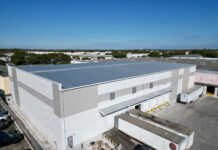
Interstate Paper’s PM1 at the new mill in Sadat Industrial City started up in June. A second similar machine is on order for start-up in July 2010.
|
IPI paper reel.
|
|
It will serve tissue converting affiliate
companies such as Sanita & Napco, and many
other local and international tissue converters.
The mill is actually designed to supply various
grades of jumbo rolls to the Middle East,
Europe and African markets to be converted
into tissue paper products, which will further
promote Egyptian exports. In fact, the exports
to Europe will benefit from low backhaul
rates.
Since the strategy of the mill was to repeat
the success of UTM in Lebanon, a fully
dedicated team from the latter moved to Egypt
to install, erect, and remain as part of the staff.
Ultimately, the mill will employ about 180
people with a wide variety of background,
and it will operate on a four-team basis
working in three 8.5 hours shifts.
|
 |
|