Tissue World Magazine


FEATURES
APRIL / MAY 2009


Classical success story
Meimari Kountouraki owns the first Futura line in Greece which, it believes, is a vital competitive advantage

It befits a tissue business which sits within sight of Mount Olympus, mythical home of the gods of classical antiquity, that its origins should make a good story on their own. Meimari Kountouraki Tissue Converting, trading under the brand Softcare in Lakkoma - around half an hour's drive from Thessaloniki - began life through an act of friendship - not so surprising in this country. Since then, the company has identified that most precious of business jewels: a niche. It has exploited this through investment in a high capacity converting line, which has now been running for just over a year.

Brothers Evripidis and Christos Kountourakis, respectively general manager and president/CEO of Meimari Kountouraki, started out on the tissue road when they helped out a friend with a small converting company who had gone bankrupt. He persuaded them to build a converting business themselves, which they ran from their friend's former city premises from 2001 for nearly three years. The brothers built up a private label business, invested in two Omet napkin machines with Multipack wrapping machines, and handled all their own distribution. From the start, however, they always had in mind the need for more space for a complete plant. The niche which Evripidis and Christos identified was for jumbo kitchen rolls. This format was traditionally seen as for away-from-home markets, but the brothers Kountourakis saw its potential as a private label product for supermarkets.

SUPER MARKETS LIKED IT

It was not long before six supermarkets had taken to the idea. Of course each customer wanted its own identity for the product and this, combined with significant volumes, started to put this fledgling business under strain. To begin with Meimari Kountouraki was importing finished product from Italy to satisfy demand, but this was never a long-term solution.

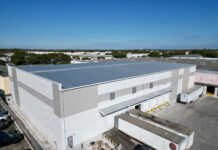
From a crowded inner city works, Meimari Kountouraki made a bid for freedom, helped by some fiscal incentives to set up enterprises out of town. In 2005, the brand new plant began to take shape. Thus, at the end of a bumpy, dusty track, visitors arrive at an impeccable 8000 m2 plant, glinting in the sunshine. A beacon of modern enterprise surrounded by fields, with the sea and Zeus's mountainous home in the background, the factory provides employment for 33 local people.

SOMETHING DIFFERENT

When it came to choosing a converting line, Evripidis and Christos knew they had to follow a different path from their competitors in Greece. There were too many similar lines and Meimari Kountouraki sought differentiation. "White tissue sold very well, but we thought we could do something better through innovation," says Christos. "We were aware that the Futura line and its embossing system would allow us to have different patterns from the competition. The possibility to use coloured embossing to create a more eye-catching product was also very appealing. The market is very competitive in Greece and product is at a high level. We had to do something different and raise quality standards even higher."

Greece is a challenging market in which to operate. While there is clearly an opportunity to increase per capita tissue use, the population is a mere 12 million, and it is not surrounded by wealthy neighbours to which it can export. There are opportunities in the Balkans, but hardly a gold mine. So Meimari Kountouraki took the approach of building market share by doing things differently.

Meimari Kountouraki's success in following its chosen path meant a new line was badly needed. All the kitchen towel product the company sold had to be imported, and this represented 40% of the business. Shortly before the Kountourakis brothers were due to specify a converting line, Spiros Panagiotidis, a well-known and respected doyen of the tissue industry, based in Athens, started to represent Futura in Greece. Futura was a relative newcomer at the time and was associated with bigger machines. The Kountourakis brothers' instinct was also that they would be too expensive.

Spiros believed otherwise, and he sat down with the brothers and Futura's Carlo Berti to see what could be done. "We gave them a shopping list of what we needed," says Evripidis. "We were specific about the number of channels of course and, with slightly different needs for each customer, we could only afford a short time between changes. So we needed a high-level machine but not at very high-level cost. I think we helped Futura to develop their philosophy of building more flexible machines."

THE LINE THEY WANTED

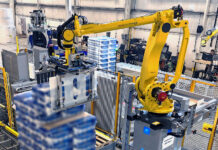
Proof that Meimari Kountouraki got what it wanted is in the form of a Futura converting line which started up in January 2008. It features complete unwind section, flexible embossing/laminating with nested technology, the innovative Futura log making system , accumulator, and cutting system including trim cutter, log loader and log saw. "Going with Futura seemed like a risk at the time," says Christos, "but we trusted the people and believed in the name of Fabio Perini who we knew was behind Futura. They promised their support and they were true to that promise." The Futura line now produces 75% kitchen towel and 25% toilet tissue. For toilet tissue, Meimari Kountouraki has started to introduce three and four ply products using nested technology. Meimari Kountouraki uses patterns on kitchen towel normally associated in Greece with toilet paper, which has earned them new customers and strong sales growth. It can also produce rolls in diameters from 100 mm to 260 mm diameter (ie from toilet rolls up to jumbo kitchen rolls) all on the same machine. The line runs at speeds between 450 and 550 m/min and pattern changeovers - very fast and simple - are made by the operators themselves. Meimari Kountouraki also runs a Microline towel packaging unit, toilet tissue is packaged on a TMC line; and there is also an Omet napkin folder. "I believe we have the best plant in Greece at the moment," says Evripidis.

Meimari Kountouraki is quietly building market share in Greece and started to export to Romania and Bulgaria last year, direct to supermarkets. As mentioned, this is not a major market, but average tissue use per capita is increasing in the Balkans, so this is the right time for the company to be making a name for itself.

A major opportunity is Aldi in Greece. Meimari Kountouraki sells its 2 x 400 g and 1 x 800 g kitchen roll units to Aldi's handful of stores in Greece, but Aldi's target is 400 stores. "The potential is interesting," says Christos, trying not to get too carried away. The fact that Aldi sells four kitchen roll products in its Greek stores, and the two of these which come from Meimari Kountouraki account between them for 70% of Aldi's kitchen roll sales, suggests this is a rather successful partnership in the making. The big achievement has been to raise the standard of private label in Greece, and find a willing market for this new level of product.


TIME TO BUILD MARKET SHARE

As for the tough market conditions which prevail to a greater or lesser extent across the world, Evripidis and Christos are philosophical. Clearly not afraid of commitment, both in terms of hours worked, and their own finances, they believe they have an opportunity. Christos: "During the crisis, people are buying less for sure, but there are some small converters in Greece which cannot compete, so while the market contracts we can grow market share. The crisis is not a matter of prices. We need to offer good service and the right product. When Italians> speak about speed and volume we now know what they mean. We are now convinced that a converting company in Greece cannot compete without the level of converting line which we have. For our customers it is a crucial fact that we have this high level of technology."

The brothers plan to buy more room to house a second converting line, which is being considered for 2010. This would be dedicated to toilet paper, thus allowing the existing line to be even more efficient, as it would be switched to 100% kitchen towel. Evripidis also points out that they will be able to run the machine themselves practically from day one, implying that Futura is likely to be the supplier again. "With the first Futura, it was our first experience with a complete automated line, so we needed Futura's help for a while," he says. "We faced challenges but Futura supported us. Since the start-up, however, nobody has needed to attend to the machine from outside. There is remote diagnostics if we need it, of course, and any software issues have always been solved online. When Futura visits now we just drink coffee!"

It will come as little surprise that Christos' wife and brother-in-law are also involved in the business. "The spirit in the Mediterranean favours family businesses," says Christos, "and this means quick decisions and flexibility. We are in a strong position to face the crisis and increase sales. We are here for the long term. All profits are reinvested in the business as well as the family's money, as finance is not necessarily easy to come by. We just need to keep innovating. We have made our dream here." TW