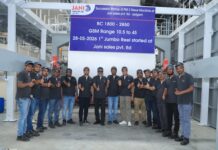
In early April, Propaper started up a new 10,000 ton/yr tissue machine
at a greenfield site at Tremembé near Taubaté in São Paulo state,
Brazil. The new machine, which trims at up to 2800 mm and can run
at up to 600 m/min, will make 100% pulp-based paper in the 16-40 g/m2
range. It is equipped with a steam-heated 3.66 m diameter yankee. "Our
focus is to produce high-level paper quality," said commercial director
and part owner of the company Carlos Silva.
Remarkably, the new machine and all ancillary equipment except
piping is made in China by Tianjin Paper Machine Co. and by Ultra Alvarez
which has manufactured a 800-1000 m/min-rewinder machine. It is
believed to be the first Chinese machine in Latin America and perhaps the
first in the world outside south-east Asia. Silva was confident, however,
that quality will not be a problem.
"Most Chinese paper machines are cylinder mould type but make good
quality paper," he told Tissue World a few weeks before start-up. "They
have good formation even at low grammage and low volume."
To some, it may seem a leap in the dark to buy a tissue machine from
China but Silva did extensive research before taking the decision to go
ahead. "Our prime idea was to set up a converting line for the products
we commercialize. However, after starting to use Chinese machines, we>
became more confident about expanding the project." Silva made many
trips to China (as well as Taiwan and Korea) with a Chinese friend as
interpreter, visiting machine works and mills using relevant equipment.
"During this period, we set up our converting line and we are already
producing the main papers that we commercialize," he said. "Among them
we have JRT-toilet paper, V-fold towel paper, N-fold towel paper, roll
towel paper and napkins. The Chinese are capable of building much better
machines these days," he believes. And with an extraordinary value:cost
relationship.
"I would not recommend this method for a big paper manufacturer
with a big demand and financial structure to support high investments.
Certainly, then I would search for a big machine manufacturer with a large
experience in converting as well as in paper manufacturing. However, in
our case, we have always been paper distributors with no paper
manufacturing experience, so that was the best option.

"The Chinese offered a production proposal according to our needs,
with investments compatible with what our resources. Such facts are very
important for a beginner paper manufacturer. Our first step was to decide
the quality of the product to be produced, the raw material to be used, and
the paper storage to be manufactured.
"We decided to produce premium products with high quality. Our aim
is to offer our customers the lowest total cost, which can be achieved only
through a proper programme involving quality product, proper dispenser
and technical support rather than just low-quality products.
"I engaged a project office in China in order to establish a complete
plant design, including utilities such as water, steam, energy and water
recovery, and the whole project was settled according to our work policy.
We thought about quality, cleanliness, arrangement and environment. We
feel proud when we receive visitors in our plant and they express their
approval," says Silva.
"Once I had researched the main Chinese manufacturers and decided
on those I was going to work with, I involved them with the project office
in a team effort, each one contributing experience and technical information
to complete the whole. I picked out a Chinese technician, Lu Huchum,
who was responsible for the team and was in touch with me in order to
take important decisions..
"Everywhere in the world, there are non-qualified equipment
manufacturers. In our case, we have opted for the best Chinese products,
not just for the lowest prices. From the plant project to the paper
manufacturing start up in Brazil, we spent about three years, including
land acquisition, licensees, civil construction, transport and assembly of
all the equipment in Brazil. Now the machine is operating, the quality
expectations have been met," Silva said in early April.
To ensure continuity of production, though, Propaper has an extensive
spares warehouse, with parts to last two years. It even has a complete spare
vacuum roll. And in case of emergency it can turn to one of the many
expert engineering companies (including paper machinery manufacturers)
located within easy reach of its plant.
Prolim already has experience of working with Chinese equipment. It runs 11 Chinese machines in its converting plant, including two log saw machines using 600 mm and 1000 mm diameter discs, all installed since 2006. So far, Silva said, the experience has been positive. The converting lines, which are located at the company's headquarters site in Taubaté, will be moved to the mill site in the next stage of the development project. The converting plant will continue to use bought-in paper as well as much of the output from the new machine. Prolim's idea is to substitute the highquality part of its programme with its own paper, while continuing to buy paper for the recycled grades.
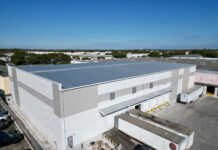
The new site is well located on the main highway,120 km from the giant metropolis of São Paulo and 280 km from Rio de Janeiro. The company has 10 hectares of land with good access to water from the River Paraiba and excellent logistics as well as transport. Taubaté, a town of about 250,000 people, has benefited from its location and facilities to attract major international investors such as Ford, Volkswagen and LG so there is a significant local market and labour pool. Propaper has had no difficulty attracting highly-qualified technical staff to run the paper mill. Water from the river will be purified in a new plant built at the mill but consumption will be modest, according to Silva. He explained that the mill runs a closed-circuit system, and the water will be treated and returned to be reused after its consumption at the plant. "We will use fresh water only for the machine showers. Therefore, the water consumption from theriver will be rather low. Capacity of the water treatment plant (water from the river used in the showers) is 50 m3/hr so there is plenty of capacity in case of need or for a future expansion at the mill, which is already allowed for in the mill design." The water recovery system capacity is 60m3/hr.
The mill has three stock preparation lines with total capacity of 60 tons/day: one line each for short fibre, long fibre and rejects. Consistency and proportioning of fibres is controlled by CLP. In total the company employs about 350 people at the two plants. Propaper employs 40 at the paper plant and about 50 at the converting one, and Prolim Distributor employs about 120 in direct sales and more than 60 at the management and the storekeeper's department. Though Prolim is a relative newcomer to paper manufacturing and converting, it has been in the paper distribution business for decades. The company was set up in the 1960s, and was founded by its president, Edgard Almeida Pinto, as a cleaning products distributor and over the past 40 years has grown to be one of the leading suppliers in Brazil, competing in the away-from-home market with the giants of the industry. It supplies a range of items, including soaps and dispensers as well as paper products. It started making chemicals in 2001 following the devaluation of the Brazilian currency. As the cost of its imported products skyrocketed and the US supplier declined to manufacture locally, Prolim had to react fast. In 4-6 months it set up its own facility, using an existing building. Its machines are built in-house and it cooperates with the important University of Campinas to ensure new product development meets market and legal requirements.
It has even developed an export market for its chemical products, though paper is sold only within Brazil. Soaps are regularly sold to Chile, Argentina and Peru. In particular, there is a strong market for odour neutralizers and hand care products.

Sales of paper products are all over Brazil. In Rio, São Paulo and Minas Gerais states, Prolim sells direct to 12,000 customers; in the rest of the vast country (8.5 million km2, just a little smaller than the USA) it uses a network of distributors and partnerships. Industry awards won over the years for service and product quality are on display at the head office, attesting to its success. "We sell a service concept: products, distribution and training," according to Silva. Its paper products cover towels, toilet and napkins.
Prolim is quite a surprise for the first-time visitor. A little-known company in the tissue industry - even major local suppliers did not know it when Tissue World visited Brazil in February - it is nonetheless housed in modern, spacious and well-equipped facilities that would do credit to a much larger company. "We are a company rather new to paper manufacturing and converting, but with a strong concept," explains Silva. "We know where we are going and we are very serious about efficiency, with strong emphasis on offering a comprehensive service to our customers. That was always the great distinguishing factor about our company." The company offers good facilities for workers as well as organized production and administrative space. The head office has a social club, restaurant and medical facilities, plus the obligatory football field. "I visit many companies and I know Prolim has a different concept," says Silva. "Each department manager has a six-month plan. Each one is responsible for developing his business. People stay with the company. We are not just a school for others. We train but we also retain people. Our business is our people. We respect them and they reciprocate."
The words are not so uncommon among company managers. In Prolim's case, though, they seem well founded in fact and that is not nearly so common.
Prolim is a family company with other business branches, including cleanliness and facilities service under Vincenzo Gaudiozo Junior, the superintendent director and the son-in-law of the company's founder. Prolim Distributor, Propaper and Prolim Chemical are under strategic and commercial management by Carlos da Silva Batista.
TW