As a storm which has brewed up in the Bay of Naples sweeps inland,
blackening the sky, and dropping rain so hard it bounces off
the road, the contrast with the animated conversation in the
brightly lit offices of Idea Tissue is striking. Just a month
after the startup of its new converting line, Idea's management
is visibly enthused by this new chapter in the company's story,
and the line's supplier is paying a visit to see how things are
going.
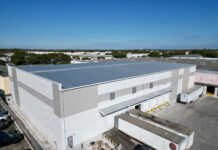
Idea Tissue converts industrial and consumer tissue for the
Italian and wider European market in its 12,000 m2 site in Poggiomarino
in the outskirts of Naples in Italy. Idea is rather new to tissue
production. The company has been trading tissue for wholesale
distribution since the early 1980s, but it was only in 2004 that
the brothers Angelo and Antonio Costante decided to invest in
converting technology and produce their own product.
This young company blends experience with youthful vigour. Where
experience was required, experience was hired, particularly on
the technical side, but the 35-strong workforce also includes
many younger people in whom the Costante's see the future of Idea
Tissue. The factory is spotless and there is a strong sense of
purpose running through the enterprise.
NEW EMBOSSING LINE
The company has recently invested in a new
converting line with embossing from Futura for multi-purpose rolls.
The investment is part of a growth project at Idea, the aim of
which is to increase capacity and improve quality.
The line started up in June 2008, and the new patterns generated
on the Futura embosser began to sell well almost immediately,
suggesting a market which is ready for added value tissue products.
The new embossing technology enables Idea not only to produce
a new range of patterns, but also to create a more absorbent tissue
product.
The new line has enabled Idea to produce a much lighter roll,
which means it is delivering the same performance to the customer
using less fibre. In its short life, the Idea brand has achieved
strong recognition, and the Futura line is part of a strategy
to invest in the brand and build its reputation for quality.
Idea is a family business - not so unusual in this part of Italy.
The Costantes grew up with the spirit of entrepreneurialism. Their
grandfather owned a soup factory during the Second World War.
His sons both went their own way in business, with Angelo and
Antonio Costante's mother and father becoming involved in the
detergent business. They developed a system for decanting 50 kg
sacks into 1 kg containers, and thus began the theme of converting,
if this is not stretching comparisons too far.
They had also invested in shops, which they started to use as
an outlet for their detergent products. With their sons now on
board, the shops evolved into supermarkets, and the brothers naturally
became familiar with tissue products and distribution in the area.
In the 1980s, they started to build up a clientele for wholesale
tissue sales.
HYPERMARKETS BRING CHANGE
The arrival of hypermarkets
signalled the need for change. These huge stores had reduced
the competitiveness of the Costante's wholesale operation. But
rather than lie down and be sidelined by the retail giants, the
brothers decided to supply them instead (as well as other retail
outlets), from a brand new converting operation. An opportunity
was also seen to supply a better product to the away-fromhome,
or professional, market. This was 2004, the year when Idea Tissue
was born.
Soon after the company was launched, Mariano Iapicca was recruited
as commercial director. With 40 years in the business, he was
well known to the family as a supplier of tissue to their shops,
and had just the insight into the market for tissue locally and
beyond which the company needed. Just a few years later, the tissue
converting venture had proved a success, and Idea was in the market
for a second converting line. This time Futura had risen to prominence
as a provider of converting solutions, thanks to many successful
installations worldwide. Futura was chosen to supply the line,
mainly because it had new ideas to bring to the table, details
of which were the subject of in-depth discussions with Futura's
sales manager Carlo Berti. The solution which Futura proposed
offered a capacity up to three times greater than line one, depending
on the roll format.
"The best way to talk about this line is to talk about
the finished product: the result of the investment is, quite simply,
that we can make better tissue. The increased capacity is of course
highly significant, too." says Iapicca.
The new Futura line features two unwinders, a laminator/embosser,
a rewinder, accumulator, and a new Janus Bandsaw which features
three channels and a revolutionary concept to cut the rolls -
a feature thought to be unique to Futura.
Unusually, the Janus bandsaw cuts with both sides of the blade,
and can process rolls of diameters from 120 mm to 450 mm. Diameter
changes from 120 mm to 300 mm can be completed from the touch
panel control. For diameter changes from 300 mm to 450 mm, a few
minor adjustments taking up to 20 minutes are required.
To put the capacity of the new line in context, the previous
solution could process
a maximum 90 rolls
per minute for diameters up to 350 mm, and this fell to 60 rolls
per minute using two channels for diameters from 350 mm to 450
mm. The Futura Janus system cuts 120 rolls per minute from 120
mm to 450 mm diameter. Band saws are traditionally slow but can
cut larger diameters than a circular blade, so the Janus does
seem to offer the best of both worlds, and the band is cheaper
to replace than a blade. "The quality
of cut is superb" says Mr Iapicca.
IT'S A FAMILY THING
The family believes strongly that it has
an important part to play in the local community, which starts
with employing local people, but does not end there. As the sun
emerges from behind the departing storm clouds, we are shown a
public open air swimming pool which the Costante's have built.
It is as immaculate as the factory - and an invaluable facility
for Poggiomarino's residents - young and old.
Family businesses have an advantage over their shareholder-owned
counterparts in that
they instinctively
prioritize longterm
growth over short-term expediency. Idea's investment in a new
converting line is certainly a long-term decision: it takes the
company into new markets and increases the efficiency of the operation.
But the fact that
this investment is
already paying dividends is welcome indeed. TW