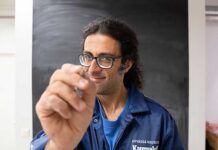
Jan Johansson
came to SCA,
Europe's largest tissue company, as CEO and President in November
2007. Previously he was CEO of the Swedish metals company Boliden,
and prior to that he had worked with major companies such as
Vattenfall and Shell Oil. The move to SCA, he says, was a little
bit like coming home to his roots as his father worked at SCA
in Sundsvall, where he grew up. He himself had also worked summer
jobs at SCA in his youth. So the change was perhaps not as great
as it might appear.
SCA is a very diversified company making hygiene products, packaging,
printing papers and forest products based in part on the enormous,
well-managed forest assets it owns in Sweden. The company has
a total turnover on the order of $14 billion and tissue is in
fact SCA's biggest business area, larger than personal care, packaging
or forest products.
Johansson, who will be the Keynote Speaker at the upcoming Tissue
World 2009 conference in Nice next March, talked recently to Tissue
World magazine about his experience so far with SCA and how things
are developing.
How has your first year on the job at SCA gone?
It has been interesting
and challenging. The changes in the business environment during
the year have certainly impacted my initial agenda. My first
objective then was to speed up the growth of the company, but
as the market has developed during the past year, we have had
to readjust. We are still focused on growth in numerous sectors
and regions, but we also have to focus more than I had anticipated
on the cost side, productivity, cash flow, etc. due to the weaker
markets like packaging in Europe.
The challenge is to be braking and accelerating at the same
time, with the same people. I should say that I have been in a
similar situation in a previous job, so it can be done. The important
thing is to create an understanding for it, both internally and
externally.
In addition, I must say that SCA is a fantastic company with
great, devoted employees and a professionalism that really encourages
me, every day. I am convinced that we can deal with the challenges
in order to fulfill our business targets.
You announced a new organization earlier in the year. What is
behind it?
I saw that we had
lots of small islands around the world within SCA that were trying
to innovate on their own. This is not efficient use of time or
money. So we introduced a new matrix organization to get to the
market faster. I think this will help us to really capitalize
on the knowledge we have within SCA both regionally and centrally.
This also helps us decide, from an overall SCA point of view,
where to spend our money and answer questions such as which market
to invest in, which category, when, how much, etc.
A good matrix organization can be difficult to introduce but
can also be extremely effective when it is done right as it gets
people to work together across categories and regions for better
results. I think you can see good examples of this at companies
like IBM and P&G. To make it work you have to be very clear
about responsibility, and measure progress. Of course you also
need to have the right people in the right place. So I am confident
it is the right strategy, but it does take time to adapt and we
are making progress.
In the European tissue market are you still following the dual
strategy of making both brands and private label?
In Europe the consumer
tissue business has been tough, with unacceptable profits and
returns below the cost of capital. This can't continue. Our ambition
is to increase our share of brands. For private label we are not
going to continue to invest and work with customers who never
give us a return on it. We have actively been leaving PL customers
where we don't see any profitability. We prefer to leave them
to someone else and instead work with customers who want to develop
together and recognize that there has to be some profitability
all along the chain.
Our brand strategy is also related to innovation in tissue products.
We know, as the retailers do as well, that it is the brands that
lead in innovations and category growth. Therefore brands are
vitally important for tissue. I think Europe is far behind the
US in innovation because it is coming from a production viewpoint,
instead of looking more at the consumer. European tissue makers
see themselves selling paper while in the US it is more functionality
that is being marketed. We need to see more of this in Europe.
How has the deal with P&G for
the Bounty, Charmin and Tempo brands changed things?
This was a great
acquisition and it is on target. We will realize SEK 700 million
in cost savings and we got these very good brands of course. This
is helping us in the transition to get higher returns, as we can
close some plants and make the supply chain much more efficient.
We are also cleaning up the brand platform and starting to work
with stronger brands. We own the Tempo brand now and can market
Bounty and Charmin under licence in Europefor an undisclosed number
of years that we are comfortable with.
With these in place we are migrating into a new brand platform
which is one of the key elements of the acquisition. As part of
this we will revise our entire present portfolio of about 20 tissue
brands so they will become much fewer. This autumn we are launching
the new platform and taking a totally new approach to tissue marketing,
unique in the business.
What is happening with your away from home tissue brand TORK?
TORK is now our truly
global AFH brand, with sales over €1 billion Euros. We have
recently carried out a big program called the TORK Revolution
to put all of our AFH tissue under the TORK name. In the US we
had some old AFH brands that we have very successfully migrated
to TORK.
We were actually surprised at how incredibly smoothly it all
went but of course there were years of work behind the success.
It was a step by step process which was well explained to the
customers, who were extremely involved in and excited about the
process. So we are very happy that it is all under one name globally
now and we are looking of course to grow further with TORK. We
also see stronger opportunities to transfer innovations among
the US and Europe and other parts of the world to drive the TORK
brand.
Where else are you growing?
Our tissue business
is growing in many parts of the world, such as Russia where we
are developing with the market and China where we have a successful
JV with Vinda, which is growing 30-40% annually based on its
strong brand. In some respects China is much like the US market
as the tissue brands are very strong. We are also growing in
tissue in Colombia and Mexico, as well as many other countries
in the personal care sector. For example, in the Middle East
we have a JV for personal care that is looking very promising.
And this Fall, we are delivering the first paper from our new
tissue machine in Barton, Alabama, US. In the US, we have established
ourselves as a leading player within AFH. The previous production
at Barton was 100,000 tons a year but with the new machine, the
production can reach 170,000 tons a year.
What are the reasons behind the big investment in a tissue mill
in Mexico?
It's a supply chain
project really. We have a good position in the market with good
distribution and excellent customer relations but we have outdated
equipment and need more efficient production there. So this project
will help us get our costs down to a better level so we can be
more profitable. It was really a question of investing to fix
the supply chain or leaving the market and we clearly see the
fix as the best alternative.
How will sustainability issues impact the tissue business?
Sustainability is
a critical issue and I am sure it is certainly not going to put
less pressure on the tissue industry. Energy and global warming
concerns are here to stay and we can see more legislation coming
in these areas. Also consumers are more aware than ever about
these topics.
I am pleased to say that we are the only company in the world
that can show that we are CO2 neutral when you look at our production.
No one else can do this. This is based on our enormous forest
assets as we are the biggest forest owner in Europe with 2.6 million
hectares of forest lands and the trees we have there are binding
2.6 million tons net of CO2. I think the forests will prove to
be even more valuable in the future.
How do you view the competition that may develop for trees based
on new EU directives for bio energy production?
The EU clearly has
ambitions to increase bio energy production. The negative side
of this is that it will create competition for trees. I hope we
will not be so stupid that we encourage burning fresh trees. From
both an environmental and a financial point of view that would
be crazy because you release the CO2 and don't add any value in
the chain. We are trying to explain this to the political world.
The positive role of the forests has been forgotten in the global
warming debate. Deforestation
gets all the headlines
and attention but the potential to absorb CO2 is huge and this
needs to be understood by politicians. In the countries where
deforestation is taking place, many people
are not thinking about
CO2. They are thinking about eating, as they need the land for
growing crops or grazing animals. But it is really a question
of incentives, if you get more money from planting than cutting,
then you will plant.
We totally agree that deforestation has to stop, but we also
want to go a step
further and get leaders
to understand that
we need to plant
more trees. Worlddeforestation
reduces global forests by
about 0.2% per year.
In Sweden we are actually growing our forests by 1% annually.
In SCA we are planting three trees for each one we harvest. Well-managed
forests are simply a fantastic opportunity when it comes to solving
the CO2 issue. It's all about photosynthesis; growing trees bind
CO2 and produce oxygen.
What about pulp mills as bio energy plants?
The pulp mills are
already today
energy plants.
Our Östrand plant delivers
more energy than
needed in the
production, and any surplus is sold on the open market. Today
the black liquor from this process is burned in a recovery boiler,
but there is quite interesting research going on for other forms
of using the black liquor. We embrace this development as long
as it doesn't lead to the burning of high-quality wood when the
black liquor is taken out of the process. TW