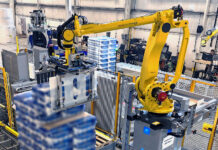
Syassky Pulp & Paper has just started up its new PM3, a
2.75 m trim Over Meccanica machine rated at 27,000 tons/yr of
tissue in the 15-40 g/m2 range. The machine, which has a design
speed of 1600 m/min, raises mill capacity to around 6000 tons/month.
It is expected to make paper for a full range of products, from
toilet tissue to towel, facial to hankies and napkins.
The paper machine will be followed in August by a new OMET unit
for two-ply napkins (100-sheet
packs 24 x 24 cm). Early
next year a new converting line from CMG will start up. It will
make three-ply toilet tissue, which will be sold in packs of up
to eight rolls, as well as other products.
These two additional phases will complete an investment program
of around 18 million, over 80% of it for the paper machine. Looking
further ahead, the company envisages a big program to improve logistics,
including a major upgrade to warehousing facilities.
With the new tissue machine, Syassky is aiming to go up market,
above all improving the softness of its current brand ‘ ’ (myagki
znak = soft sound).
One of the problems it faces is the relative hardness of the paper
it produces using pulp from its integrated mill, which makes 120,000
tons/yr of bleached sulphite pulp largely from local hardwood.
It needs to buy more softwood to supplement this, according to
marketing management, but the cost involved is discouraging.
While NBKP is selling on the international market for $800+, the
mill’s own selling price for its market pulp is not much
more than half that.
And at the same time
the cost of wood for
the mill has risen sharply:
from Rb700/m3 (about €20) to Rb1500/m3
in two steps last year.
The problem has been
the warmer winters
experienced in the Nordic
countries and northwestern
Russia in the last couple of
years, which have made
harvesting far more difficult.
As a result, the supply
has been down and Finns
and Swedes have been buying in Russia to supplement their domestic
resources. The price appears to have stabilized now but the mill
fears continued increases in the future.
Today, the mill is one of the acknowledged leaders among domestic
companies. It sells most of its output in Russia and the former
USSR states of Ukraine, Belorussia, Kazakhstan, Latvia and so on.
With the improved quality it expects from PM3, it aims to expand
sales into Western and Central Europe.
This may be necessary because – unlike some Russian commentators – Syassky
believes Russian consumption really is only about 2 kg per person
per year. Even in Moscow and St Petersburg, consumption is only
about 5-6 kg/yr, according to marketing management. There may not
be enough domestic demand to cope with its new production as well
as that from developments elsewhere, notably the new machine at
Svetogorsk, even if demand grows at the expected 10%/yr for the
foreseeable future – a mere 25-30,000 tons/yr for the whole
country.
Within the Russian market, Moscow and St Petersburg account for
about 40% each, while the remaining 20% goes mainly to cities in
the south and the Urals. Most sales are through super- and hypermarkets
and the bigger retailers: X5, Lenta, Okey, Dixy, Karusel and Auchan.
Very little mom and pop shop business is done.
Some 70% of sales are in toilet paper, 20% in napkins and hankies,
with the rest split between kitchen towel (5% but growing fast)
and other grades.
The lower end of the quality range is aimed above all at buyers
with earnings of less than $500/month. The two-ply market will
be concentrated among those earning around $1000/month, according
to the company. For the premium grades, Syassky cannot today compete
with K-C but the company is optimistic that improvements in technology
and working systems will help close the gap.

Today the company has no private label sales, despite their popularity
in Russia (every major retailer has its own). It prefers to sell
everything under the ‘ ’ brand. That may have to change
when output from the planned converting line comes on line, but
private label is of little interest to Syassky, even in the tempting
Western European market, given the pressure on prices.
One of the main problems facing the company – and indeed
all other Russian organisations with vision beyond the merely local – is
the poor infrastructure. Transport, even from Syassky’s mill
near St Petersburg to Moscow, on the most important stretch of
road in Russia, is difficult. Beyond that the problems multiply.
The logistics of getting product to farflung outposts simply does
not add up economically.
Syassky now has capacity to produce 5000 tons/month of paper. Demand
for its own brand is currently only 3000 tons, though it is expected
to rise rapidly to 4000 tons/month. That still leaves 1000 tons/month.
Small local converters offer a ready market for a significant tonnage
that could be sold as jumbo rolls. TW