Two extremely important issues are facing the planet earth today
and they are very directly connected. These are energy prices
and carbon emissions.
The connection, put quite
simply, goes like this: energy production via combustion (or burning)
mainly consists of breaking the bonds of hydrocarbon chains (complex
molecules composed of millions of carbon and hydrogen atoms found,
for example, in oil, gas, coal, wood, etc). Through the introduction
of oxygen, the bonds are broken by an exothermic reaction, meaning
that heat is liberated. This heat is then used to power engines,
generate electricity, warm buildings, and do other ‘work’.
At the same time, the
C and H molecules are recombined with O to form water vapor, H2O,
and carbon dioxide, CO2. Carbon dioxide, as we all have learned,
is the bad guy in the global warming scenario as it traps heat
in the earth’s atmosphere in what is described
as the greenhouse effect.
This in turn raises average global temperatures, melting glaciers,
raising sea levels, causing coastal flooding and many other nasty
effects, if we believe Al Gore and others. If we believe George
Bush, it is all a very natural part of the cycles that the earth
goes through. Frankly I don’t believe much of what George
Bush says, so I give Al the benefit of the doubt on this one in
deference to my children and one day, perhaps, to my childrens’ childrens’ children.
Getting back to today, two things are clear: 1. Energy prices are
going through the roof. 2. Much of the power produced on earth
comes from sources that are not very good for the environment.
The challenge, both for the future of the planet and the survival
of some industries and companies (look at the airline industry
being brought to its knees by high fuel prices), is to find major
new sources of energy and power that come not from burning limited,
non-renewable fossil fuels but instead from cleaner, renewable
sources.
This will not be an easy task. But I am very confident that it
will be done. Prices are now high enough to justify all sorts of
research programs that were just not economically attractive in
the days of cheap oil, which is pretty much all of the last 150
years since it started being used on a large scale. By bringing
together the collective brainpower of scientists, researchers,
business people and entrepreneurs, new solutions will certainly
be found.
The sun is a pretty good
place to start. I once learned in a university course on wood chemistry
(a pretty specialised field, I admit, though fascinating) that
all energy sources on the face of the earth, except for nuclear
power, come from the sun. It seemed incredible but as we discussed
it, it became clear the professor was essentially right. Oil, coal,
wood and other such fuels ‘grew up’ in
one way or another thanks to the sun. Then, after years, thousands
of years or millions of years, these were transformed into another
state but are still based on that original sun-capturing photosynthesis
process.
Water power, as in Niagara Falls and Three Gorges, is in turn due
to the sun evaporating water, taking it into the sky and dropping
it elsewhere to once again run downhill, turn turbines and begin
the process again. Windmills, in use for centuries and today making
a high-tech comeback, are powered by wind currents created by thermal
energy gradients due to, of course, the sun. Some new sources such
as tidal power might be excluded from ‘sun-based’ energy
(moon-based?) but my guess is that the solution to dwindling oil
reserves and exploding carbon emissions will likely be based on
more efficient capture of the sun’s power on a very large
scale.
ENERGY SQUARE , E2
To help to bring about energy-effective solutions for the global
pulp and paper industry,
the Energy Square, or
E2 , was launched in April. Sponsored by numerous organisations,
with an industry coalition known as the Paper Province in the area
of Karlstad, Sweden, one of the main backers, the idea is for E2
to serve as a catalyst and facilitator for the development and
implementation of energy efficient products, processes, services
and solutions for the pulp & paper industry. This is not just
for tissue making but for the entire P&P industry.
The aim of E2 is to eventually be the hub in a network of expertise
in the area of energy efficiency which will include universities,
research institutes, pulp and paper mills, supplier companies and
industry consultants. By facilitating contacts, interchange and
resource allocation between numerous key people and groups in this
network, it is anticipated that E2 will be able to shorten the
lead-time for bringing an idea from the conceptual stage through
to market introduction.
The idea is a work in progress and the group’s board has
so far only had a few meetings but the framework is something that
I think the industry can believe in. By making contacts easier
and putting key people, ideas and resources together in various
parts of the world, the hope is that good results can be achieved
at a faster rate. Essentially 2 plus 2 can equal 5 (or more) if
this is carried out correctly.
The pressure to find more energy effective methods of making pulp,
paper and tissue products is not just a result of cost restraints.
The consumer, the person who buys that paper or tissue product,
is starting to look more carefully at the environmental impact
of that product, in particular the carbon emissions.
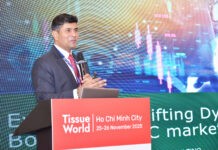
There was an excellent speech in Miami recently at the Tissue World
Americas conference on the nascent issue of carbon footprint and
labeling of consumer products. How much carbon dioxide was emitted
in the production of this bag of potato chips or that pair of shoes,
or this box of facial tissue? How does that compare with the competition?
Might it be better to buy the product with the lower carbon footprint
and thereby (hopefully) help reduce global warming? Consumers are
starting to think like this.
“Clearly it is a question of when, and not if, carbon labels
will come to tissue,” said Roland McKinney of Fibre Research
Consultants. Based in the UK, McKinney said that country has been
the leader in the use of carbon footprint labels. They were launched
in April 2007 when the first consumer product, potato chips, carried
on its wrapping bag the estimated carbon dioxide emissions arising
from making the product. Numerous consumer product manufacturers,
including producers such as Cadbury, PepsiCo and Timberland, as
well as major retailers like Boots and Tesco (in the UK) and Wal-Mart
(USA) have indicated that they plan to introduce carbon labels
for all the products on their shelves. It is going to happen although
it should be pointed out that carbon labeling is far from simple
as methodologies and calculations will be open to dispute, in a
similar fashion to Life Cycle Analysis and Eco-labels.
SOMETHING HAS TO CHANGE
The bottom line is that people in the developed world have been
living for too long in an artificial situation where a small percentage
of the world’s population is consuming the vast majority
of resources, whether energy, food, water, minerals or whatever.
As energy plays such a key role in the production and processing
of so many other products, clearly higher energy prices mean higher
overall prices.
So the challenge is now unmistakable. The opportunities, too, are
out there though perhaps a little harder to spot. However, with
some hard work and perhaps a bit of luck, the paper industry might
just be able to kill two birds with one stone: Bring down energy
consumption and reduce carbon emissions at the same time. Stay
tuned for progress on these issues and keep your eyes wide open
for opportunities that this new situation is certain to provide.TW